
Ch.5 - Periodicity & Electronic Structure of Atoms
McMurry - Chemistry 8th Edition
McMurry8th EditionChemistryISBN: 9781292336145당신이 사용하는 게 아니라요?교과서 변경
5장, 문제 53

The work function of calcium metal is kJ/mol, which corresponds to light with a wavelength of 432 nm. Which of the following will cause the largest number of electrons to be ejected from cesium? (a) High-amplitude wave with a wavelength of 400 nm (b) Low-amplitude wave with a wavelength of 400 nm (c) High-amplitude wave with a wavelength of 450 nm (d) Low-amplitude wave with a wavelength of 450 nm

검증된 단계별 안내
1
Understand the concept of work function, which is the minimum energy needed to remove an electron from the surface of a metal. This energy is related to the frequency and wavelength of light through the equation: \( E = \frac{hc}{\lambda} \), where \( E \) is the energy, \( h \) is Planck's constant, \( c \) is the speed of light, and \( \lambda \) is the wavelength.
Recognize that only light with a wavelength shorter than a certain threshold can eject electrons, as it must have enough energy (greater than or equal to the work function) to overcome the binding energy of the electrons in the metal.
Compare the wavelengths given in the options to the threshold wavelength (432 nm for calcium, but consider the similar behavior for cesium). Light with a wavelength shorter than 432 nm will have enough energy to eject electrons.
Assess the impact of amplitude on the photoelectric effect. Amplitude affects the intensity (number of photons) of the light but not the energy per photon. Higher amplitude means more photons, thus potentially ejecting more electrons if the photons have sufficient energy.
Conclude that among the options, the high-amplitude wave with a wavelength of 400 nm (option a) will cause the largest number of electrons to be ejected, as it has both sufficient energy per photon (wavelength shorter than 432 nm) and a higher number of photons due to its high amplitude.

비슷한 문제에 대한 검증된 영상 답변:

이 영상 해법은 위 문제에 도움이 된다고 튜터들이 추천한 것입니다.
영상 길이:
5m

주요 개념

질문에 올바르게 답하기 위해 반드시 이해해야 하는 핵심 개념들은 다음과 같습니다.

Photoelectric Effect

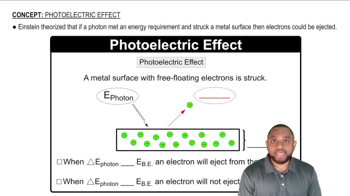
The photoelectric effect is the phenomenon where electrons are emitted from a material when it absorbs light of sufficient energy. This energy is determined by the wavelength of the light, with shorter wavelengths corresponding to higher energy photons. The work function is the minimum energy required to eject an electron from the surface of a material, and if the incoming light's energy exceeds this threshold, electrons will be emitted.
추천 영상:
가이드 코스
02:31
Photoelectric Effect

Wavelength and Energy Relationship

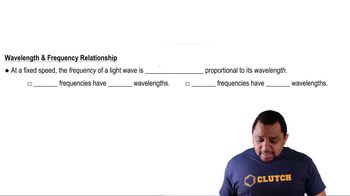
The energy of a photon is inversely related to its wavelength, described by the equation E = hc/λ, where E is energy, h is Planck's constant, c is the speed of light, and λ is the wavelength. Thus, shorter wavelengths (like 400 nm) have higher energy than longer wavelengths (like 450 nm). This relationship is crucial for determining whether a photon can eject electrons from a given material based on its work function.
추천 영상:
가이드 코스
00:31
Frequency-Wavelength Relationship

Amplitude of Light Waves

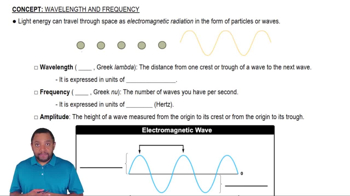
The amplitude of a light wave relates to its intensity, which affects the number of photons present but not their energy. In the context of the photoelectric effect, while higher amplitude light can increase the number of photons hitting the surface, it does not change the energy of individual photons. Therefore, to maximize electron ejection, the wavelength must be appropriate to exceed the work function, regardless of amplitude.
추천 영상:
가이드 코스
2:58
Electromagnetic Waves