What is the de Broglie wavelength in meters of a baseball weighing 145 g and traveling at 156km/h? Why do we not observe this wavelength?
검증된 단계별 안내
1
Convert the mass of the baseball from grams to kilograms. Since 1 kg = 1000 g, divide the mass in grams by 1000.
Convert the velocity of the baseball from kilometers per hour to meters per second. Use the conversion factor where 1 km/h is approximately equal to 0.27778 m/s.
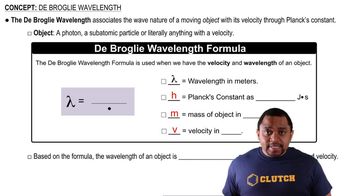
Use the de Broglie wavelength formula: \(\lambda = \frac{h}{mv}\), where \(\lambda\) is the wavelength, \(h\) is the Planck constant (approximately \(6.626 \times 10^{-34} \text{ Js}\)), \(m\) is the mass in kilograms, and \(v\) is the velocity in meters per second.
Substitute the mass and velocity values into the de Broglie equation to calculate the wavelength.
The reason we do not observe this wavelength in everyday life is because the wavelength calculated is extremely small, typically on the order of magnitude of 10^{-34} meters or smaller, which is much smaller than the size of atoms. This makes the wave properties of such large objects undetectable in practical scenarios.
비슷한 문제에 대한 검증된 영상 답변:
이 영상 해법은 위 문제에 도움이 된다고 튜터들이 추천한 것입니다.
영상 길이:
2m
영상 재생:
0 댓글
주요 개념
질문에 올바르게 답하기 위해 반드시 이해해야 하는 핵심 개념들은 다음과 같습니다.
de Broglie Wavelength
The de Broglie wavelength is a concept in quantum mechanics that relates the wavelength of a particle to its momentum. It is given by the formula λ = h/p, where λ is the wavelength, h is Planck's constant (6.626 x 10^-34 Js), and p is the momentum of the particle. For macroscopic objects like a baseball, the wavelength is extremely small, making it difficult to observe.
Momentum is a physical quantity defined as the product of an object's mass and its velocity (p = mv). In the context of the de Broglie wavelength, momentum plays a crucial role as it directly influences the wavelength of a particle. For a baseball weighing 145 g and traveling at 156 km/h, calculating its momentum is essential to determine its corresponding de Broglie wavelength.
Wave-particle duality is a fundamental principle of quantum mechanics stating that every particle exhibits both wave and particle properties. While this duality is observable in microscopic particles like electrons, it is not noticeable in macroscopic objects such as baseballs due to their large mass and the resulting minuscule wavelengths. This is why we do not observe the de Broglie wavelength of everyday objects.