Ch.5 - Periodicity & Electronic Structure of Atoms
McMurry - Chemistry 8th Edition
McMurry8th EditionChemistryISBN: 9781292336145당신이 사용하는 게 아니라요?교과서 변경
5장, 문제 1

Which wave corresponds to higher energy radiation? (LO 5.1) (a)
(b)

검증된 단계별 안내
1
Identify the relationship between wavelength and energy. Recall that energy (E) of a wave is inversely proportional to its wavelength (\(\lambda\)), as described by the equation \(E = \frac{hc}{\lambda}\), where \(h\) is Planck's constant and \(c\) is the speed of light.
Determine the wavelengths of the waves in options (a) and (b). If not directly given, use any provided information or context clues to infer or calculate the wavelengths.
Compare the wavelengths of the two waves. The wave with the shorter wavelength will have higher energy, according to the inverse relationship between energy and wavelength.
Conclude which wave, (a) or (b), has the shorter wavelength and therefore corresponds to higher energy radiation.
Apply this understanding to any further analysis or questions related to the properties of electromagnetic radiation and their implications in various contexts.

비슷한 문제에 대한 검증된 영상 답변:

이 영상 해법은 위 문제에 도움이 된다고 튜터들이 추천한 것입니다.
영상 길이:
1m

주요 개념

질문에 올바르게 답하기 위해 반드시 이해해야 하는 핵심 개념들은 다음과 같습니다.

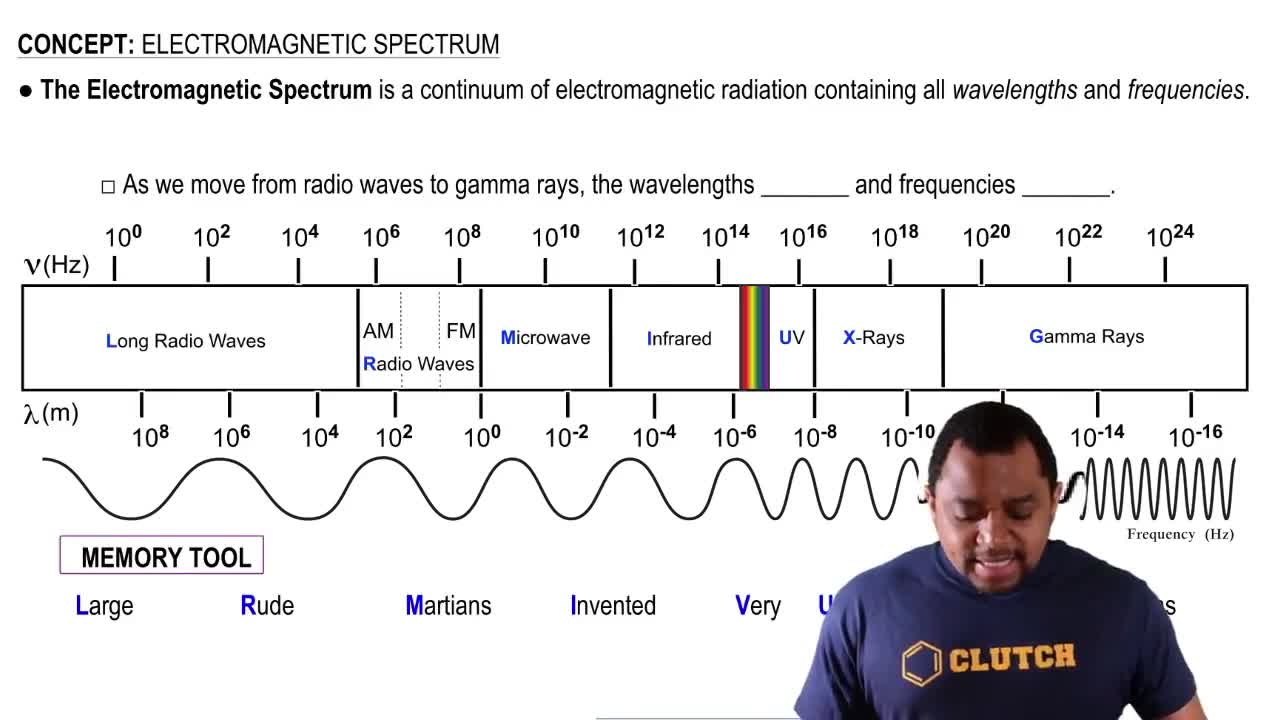
Electromagnetic Spectrum

The electromagnetic spectrum encompasses all types of electromagnetic radiation, arranged by wavelength and frequency. It ranges from radio waves with long wavelengths to gamma rays with very short wavelengths. Higher energy radiation corresponds to shorter wavelengths and higher frequencies, which are found at the ultraviolet, X-ray, and gamma-ray regions of the spectrum.
추천 영상:
가이드 코스
02:53
Electromagnetic Spectrum

Energy-Frequency Relationship

The energy of a photon is directly proportional to its frequency and inversely proportional to its wavelength, as described by the equation E = hν, where E is energy, h is Planck's constant, and ν is frequency. This means that as the frequency of radiation increases, so does its energy, making high-frequency waves like X-rays and gamma rays more energetic than lower-frequency waves like radio waves.
추천 영상:
가이드 코스
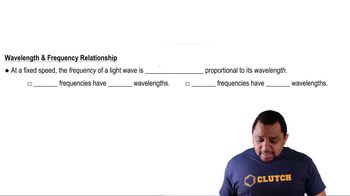
00:31
Frequency-Wavelength Relationship

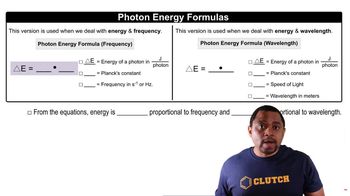
Photon Energy

Photons are the fundamental particles of light and other forms of electromagnetic radiation. The energy of a photon is quantized and can be calculated using the formula E = hc/λ, where h is Planck's constant, c is the speed of light, and λ is the wavelength. Thus, shorter wavelengths correspond to higher energy photons, which is crucial for understanding the nature of radiation and its effects.
추천 영상:
가이드 코스
01:40
Photon Energy Formulas