Ch.6 - Ionic Compounds: Periodic Trends and Bonding Theory
McMurry - Chemistry 8th Edition
McMurry8th EditionChemistryISBN: 9781292336145당신이 사용하는 게 아니라요?교과서 변경
6장, 문제 100

Many early chemists noted a diagonal relationship among ele-ments in the periodic table, whereby a given element is some-times more similar to the element below and to the right than it is to the element directly below. Lithium is more similar to magnesium than to sodium, for example, and boron is more similar to silicon than to aluminum. Use your knowledge about the periodic trends of such properties as atomic radii and Zeff to explain the existence of diagonal relationships.

검증된 단계별 안내
1
Understand the concept of diagonal relationships: In the periodic table, elements in the same group (vertical column) typically have similar properties. However, some elements show similarities with elements in the next period and group, forming a diagonal relationship.
Consider atomic radii: As you move across a period from left to right, atomic radii decrease due to increased effective nuclear charge (Z_eff), which pulls electrons closer to the nucleus. As you move down a group, atomic radii increase due to the addition of electron shells.
Examine effective nuclear charge (Z_eff): Z_eff is the net positive charge experienced by valence electrons. It increases across a period as protons are added to the nucleus, but remains relatively constant down a group because the increase in nuclear charge is offset by increased electron shielding.
Relate these trends to diagonal relationships: Elements diagonally related (e.g., lithium and magnesium) have similar Z_eff and atomic radii because the increase in Z_eff across a period is balanced by the increase in atomic size down a group, leading to similar chemical properties.
Apply this understanding to specific examples: For lithium and magnesium, both have similar Z_eff and atomic radii, making their chemical properties more alike than lithium and sodium, which are in the same group but have different Z_eff and atomic radii.

비슷한 문제에 대한 검증된 영상 답변:

이 영상 해법은 위 문제에 도움이 된다고 튜터들이 추천한 것입니다.
영상 길이:
6m

주요 개념

질문에 올바르게 답하기 위해 반드시 이해해야 하는 핵심 개념들은 다음과 같습니다.

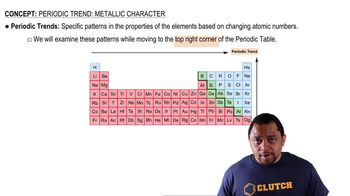
Periodic Trends

Periodic trends refer to the predictable patterns observed in the properties of elements as you move across or down the periodic table. Key trends include atomic radius, ionization energy, and electronegativity. Understanding these trends helps explain why certain elements exhibit similar properties, even if they are not in the same group.
추천 영상:
가이드 코스
00:38
Periodic Trends

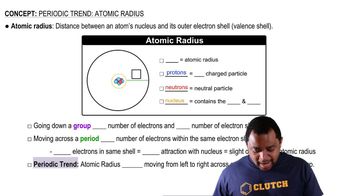
Atomic Radius

Atomic radius is the distance from the nucleus of an atom to the outermost electron shell. As you move down a group in the periodic table, the atomic radius increases due to the addition of electron shells. Conversely, moving across a period from left to right generally decreases the atomic radius due to increased nuclear charge, which pulls electrons closer to the nucleus.
추천 영상:

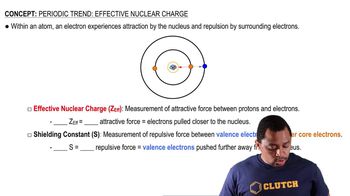
Effective Nuclear Charge (Zeff)

Effective nuclear charge (Zeff) is the net positive charge experienced by an electron in a multi-electron atom. It accounts for the shielding effect of inner-shell electrons. As Zeff increases across a period, it leads to stronger attraction between the nucleus and valence electrons, influencing properties like atomic size and ionization energy, which are crucial for understanding diagonal relationships.
추천 영상:
가이드 코스
01:51
Effective Nuclear Charge