Ch.6 - Ionic Compounds: Periodic Trends and Bonding Theory
McMurry - Chemistry 8th Edition
McMurry8th EditionChemistryISBN: 9781292336145당신이 사용하는 게 아니라요?교과서 변경
6장, 문제 42

What is the electron configuration of Ti2+?

검증된 단계별 안내
1
Step 1: Identify the atomic number of titanium (Ti), which is 22. This means a neutral titanium atom has 22 electrons.
Step 2: Write the electron configuration for a neutral titanium atom. The configuration is: \(1s^2 2s^2 2p^6 3s^2 3p^6 4s^2 3d^2\).
Step 3: Recognize that \(Ti^{2+}\) means the titanium atom has lost 2 electrons.
Step 4: Remove electrons starting from the outermost shell. Electrons are removed from the 4s orbital first, followed by the 3d orbital if necessary.
Step 5: Adjust the electron configuration by removing 2 electrons from the 4s orbital: \(1s^2 2s^2 2p^6 3s^2 3p^6 3d^2\).

주요 개념

질문에 올바르게 답하기 위해 반드시 이해해야 하는 핵심 개념들은 다음과 같습니다.

Electron Configuration

Electron configuration describes the distribution of electrons in an atom's orbitals. It follows the Aufbau principle, which states that electrons fill the lowest energy orbitals first, and is typically represented using a notation that indicates the number of electrons in each subshell (s, p, d, f). Understanding this concept is crucial for determining the electron arrangement in ions and neutral atoms.
추천 영상:
가이드 코스
01:33
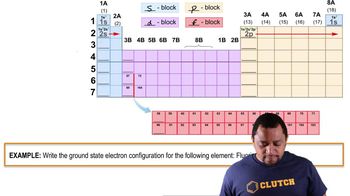
Electron Configuration Example

Ionization and Charge

Ionization refers to the process of adding or removing electrons from an atom, resulting in the formation of ions. The charge of an ion indicates the difference between the number of protons and electrons. For Ti2+, the '2+' signifies that two electrons have been removed from the neutral titanium atom, which has an atomic number of 22, leading to a total of 20 electrons in the ion.
추천 영상:
가이드 코스
01:19
Ionization Energy

Transition Metals and d-Orbitals

Transition metals, such as titanium, have partially filled d-orbitals, which play a significant role in their chemical properties and electron configurations. The electron configuration of transition metals can be complex due to the involvement of d-orbitals, especially when forming ions. For Ti2+, the removal of electrons typically occurs from the 4s orbital before the 3d orbital, which is essential for accurately determining its electron configuration.
추천 영상:
가이드 코스
02:06
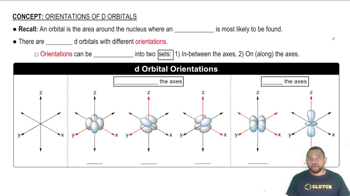
d Orbital Orientations