Ch.6 - Ionic Compounds: Periodic Trends and Bonding Theory
McMurry - Chemistry 8th Edition
McMurry8th EditionChemistryISBN: 9781292336145당신이 사용하는 게 아니라요?교과서 변경
6장, 문제 74a,c,d

What noble-gas configurations and charge are the following elements likely to attain in reactions in which they form ions? (a) N (c) S (d) Br

검증된 단계별 안내
1
Identify the electron configuration of sulfur (S). Sulfur has an atomic number of 16, so its electron configuration is \$1s^2 2s^2 2p^6 3s^2 3p^4$.
Determine the nearest noble gas to sulfur. The nearest noble gas before sulfur in the periodic table is neon (Ne), which has an electron configuration of \$1s^2 2s^2 2p^6$.
Assess how sulfur can achieve a stable electron configuration similar to a noble gas. To attain a noble gas configuration, sulfur can gain two electrons to fill its 3p orbital, resulting in the electron configuration \$1s^2 2s^2 2p^6 3s^2 3p^6$, which is the same as the noble gas argon (Ar).
Determine the charge of the ion when sulfur gains two electrons. By gaining two electrons, sulfur forms a sulfide ion (S^2-).
Conclude that sulfur is likely to attain a noble-gas configuration similar to argon (Ar) with a charge of 2- in reactions where it forms ions.

비슷한 문제에 대한 검증된 영상 답변:

이 영상 해법은 위 문제에 도움이 된다고 튜터들이 추천한 것입니다.
영상 길이:
3m

주요 개념

질문에 올바르게 답하기 위해 반드시 이해해야 하는 핵심 개념들은 다음과 같습니다.

Noble Gas Configuration

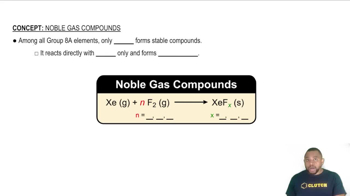
Noble gas configuration refers to the electron arrangement of noble gases, which have full outer electron shells, making them stable and unreactive. Elements tend to achieve this configuration by gaining, losing, or sharing electrons during chemical reactions. For example, sulfur (S) can gain two electrons to achieve the electron configuration of argon, a noble gas.
추천 영상:
가이드 코스
00:59
Noble Gas Compounds

Ion Formation

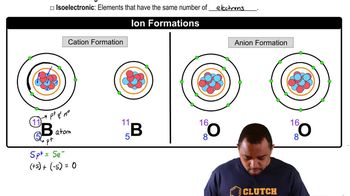
Ion formation occurs when atoms gain or lose electrons to achieve a more stable electronic configuration. Cations are positively charged ions formed by losing electrons, while anions are negatively charged ions formed by gaining electrons. In the case of sulfur, it typically forms an anion (S²⁻) by gaining two electrons to reach a stable noble gas configuration.
추천 영상:

Charge of Ions

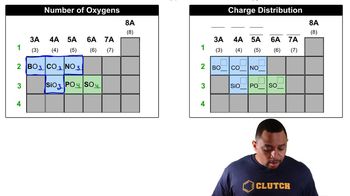
The charge of an ion is determined by the difference between the number of protons and electrons in an atom. A neutral atom has equal numbers of protons and electrons, but when it gains or loses electrons, it becomes charged. For sulfur, when it gains two electrons to form S²⁻, it has a net charge of -2, indicating it has two more electrons than protons.
추천 영상:
가이드 코스
01:39
Polyatomic Ion Charges