Which element in each of the following sets has the smallest first ionization energy, and which has the largest? (a) Li, Ba, K (b) B, Be, Cl (c) Ca, C, Cl
검증된 단계별 안내
1
Step 1: Understand the concept of first ionization energy, which is the energy required to remove the outermost electron from a neutral atom in the gaseous state.
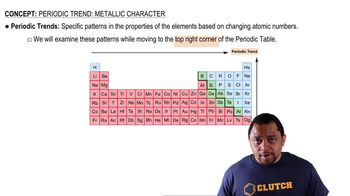
Step 2: Recall the periodic trend for ionization energy: it generally increases across a period (left to right) and decreases down a group (top to bottom) in the periodic table.
Step 3: Analyze set (a) Li, Ba, K: Identify their positions in the periodic table. Li is in Group 1, Period 2; Ba is in Group 2, Period 6; K is in Group 1, Period 4. Compare their positions to determine the trend.
Step 4: Analyze set (b) B, Be, Cl: Identify their positions in the periodic table. B is in Group 13, Period 2; Be is in Group 2, Period 2; Cl is in Group 17, Period 3. Compare their positions to determine the trend.
Step 5: Analyze set (c) Ca, C, Cl: Identify their positions in the periodic table. Ca is in Group 2, Period 4; C is in Group 14, Period 2; Cl is in Group 17, Period 3. Compare their positions to determine the trend.
주요 개념
질문에 올바르게 답하기 위해 반드시 이해해야 하는 핵심 개념들은 다음과 같습니다.
Ionization Energy
Ionization energy is the energy required to remove an electron from an atom in its gaseous state. It is a key factor in determining an element's reactivity and is influenced by the atomic size and the effective nuclear charge. Generally, ionization energy increases across a period due to increasing nuclear charge and decreases down a group as the outer electrons are further from the nucleus.
Periodic trends refer to the predictable patterns observed in the properties of elements as you move across periods (rows) and down groups (columns) in the periodic table. For ionization energy, it typically increases from left to right across a period and decreases from top to bottom within a group. Understanding these trends helps in predicting the ionization energies of different elements.
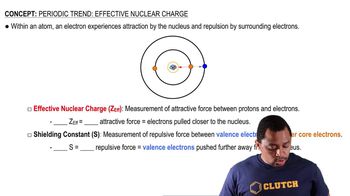
Effective nuclear charge (Z_eff) is the net positive charge experienced by an electron in a multi-electron atom. It accounts for the shielding effect of inner electrons that reduces the full nuclear charge. A higher effective nuclear charge leads to a stronger attraction between the nucleus and the outer electrons, resulting in higher ionization energies, especially for elements with fewer electron shells.


 검증된 단계별 안내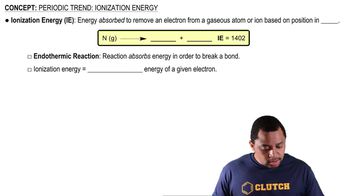
 01:19
01:19