Ch.6 - Ionic Compounds: Periodic Trends and Bonding Theory
McMurry - Chemistry 8th Edition
McMurry8th EditionChemistryISBN: 9781292336145당신이 사용하는 게 아니라요?교과서 변경
6장, 문제 47

Which element in the transition-metal series Sc through Zn has five unpaired electrons in its +3 ion?

검증된 단계별 안내
1
Step 1: Understand that the transition metals Sc through Zn are in the 3d series of the periodic table. The electron configurations of these elements involve filling the 3d subshell.
Step 2: Recall that the +3 ion means that three electrons have been removed from the atom. In transition metals, these electrons are typically removed from the 4s subshell first, and then from the 3d subshell.
Step 3: Identify the element that, when three electrons are removed, will have five unpaired electrons remaining. This means the neutral atom must have eight electrons in its 3d subshell.
Step 4: Look at the periodic table and find the element in the 3d series that has eight electrons in its 3d subshell. This is the element that will have five unpaired electrons in its +3 ion.
Step 5: Remember that the number of electrons in the 3d subshell corresponds to the group number of the element in the periodic table. So, the element you're looking for is in group 8 of the transition metals.

비슷한 문제에 대한 검증된 영상 답변:

이 영상 해법은 위 문제에 도움이 된다고 튜터들이 추천한 것입니다.
영상 길이:
3m
도움이 되었나요?

주요 개념

질문에 올바르게 답하기 위해 반드시 이해해야 하는 핵심 개념들은 다음과 같습니다.

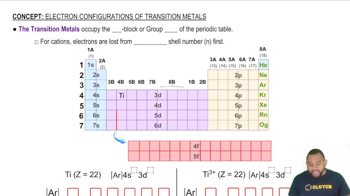
Transition Metals

Transition metals are elements found in groups 3 to 12 of the periodic table. They are characterized by their ability to form variable oxidation states and complex ions, as well as their unique electron configurations, which often involve the d-orbitals. Understanding their electron configurations is crucial for predicting their chemical behavior and properties.
추천 영상:
가이드 코스
03:12
Transition Metals

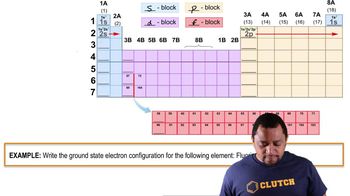
Electron Configuration

Electron configuration describes the distribution of electrons in an atom's orbitals. For transition metals, the d-orbitals play a significant role in determining the number of unpaired electrons. The electron configuration can change when an atom forms ions, as electrons are lost from the outermost orbitals, affecting the number of unpaired electrons.
추천 영상:
가이드 코스
01:33
Electron Configuration Example

Unpaired Electrons

Unpaired electrons are electrons that occupy an orbital alone rather than in pairs. The number of unpaired electrons in an atom or ion influences its magnetic properties and reactivity. In transition metals, the presence of unpaired electrons in their d-orbitals is key to understanding their oxidation states and the formation of various ions.
추천 영상:
가이드 코스
04:44
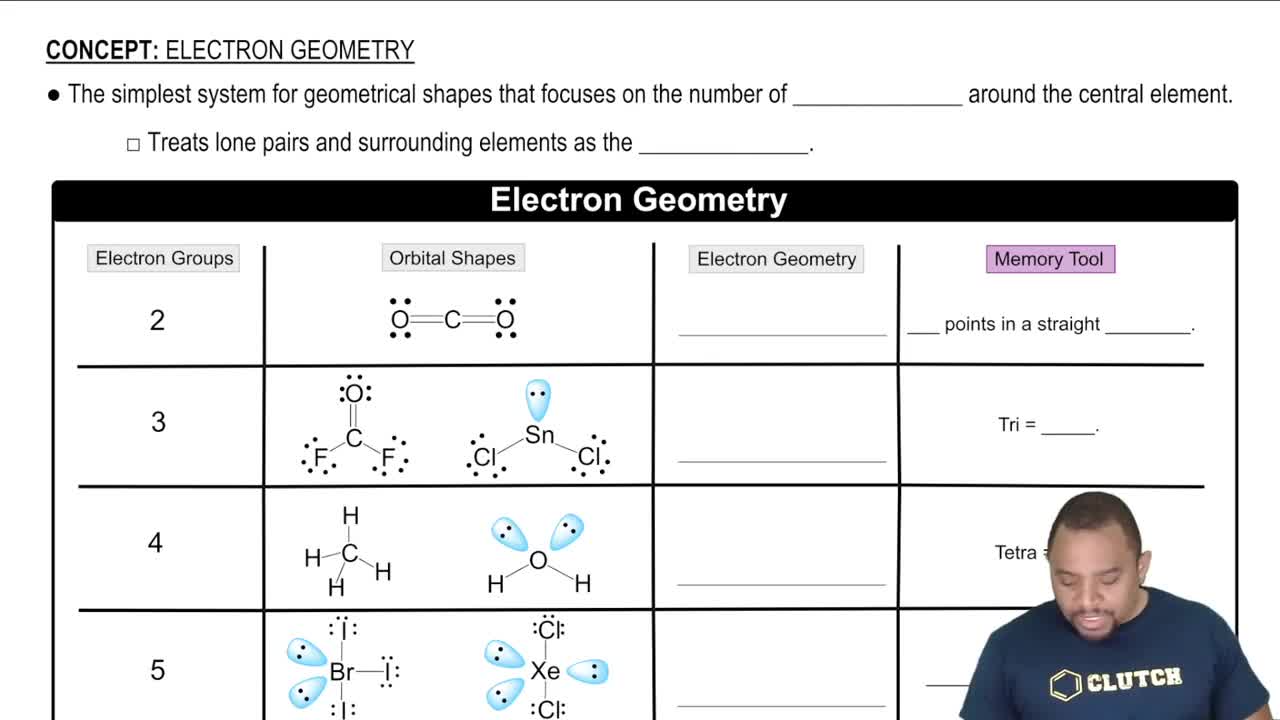
Electron Geometry