Which ion has a larger atomic radius, Cu+ or Cu2+? Explain your reasoning.
검증된 단계별 안내
1
Step 1: Understand that atomic radius is the distance from the center of an atom's nucleus to its outermost electron. In ions, the atomic radius is affected by the number of electrons and protons.
Step 2: Recognize that Cu+ and Cu2+ are ions of the same element, copper. Cu+ has lost one electron, while Cu2+ has lost two electrons. Both ions have the same number of protons.
Step 3: Recall that the more protons an ion has, the stronger the pull on the electrons (due to the positive charge of the protons). This pull is called the effective nuclear charge.
Step 4: Understand that when an ion loses electrons and becomes positively charged (like Cu+ and Cu2+), the effective nuclear charge increases. This means the remaining electrons are pulled closer to the nucleus, decreasing the atomic radius.
Step 5: Conclude that since Cu2+ has lost more electrons than Cu+, it has a higher effective nuclear charge and therefore a smaller atomic radius than Cu+.
비슷한 문제에 대한 검증된 영상 답변:
이 영상 해법은 위 문제에 도움이 된다고 튜터들이 추천한 것입니다.
영상 길이:
1m
영상 재생:
0 댓글
주요 개념
질문에 올바르게 답하기 위해 반드시 이해해야 하는 핵심 개념들은 다음과 같습니다.
Atomic Radius
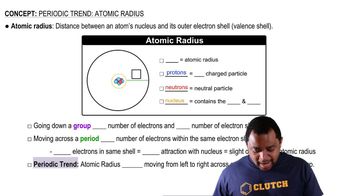
Atomic radius refers to the distance from the nucleus of an atom to the outermost shell of electrons. It is influenced by the number of electron shells and the effective nuclear charge experienced by the outer electrons. Generally, atomic radius increases down a group in the periodic table and decreases across a period due to increased nuclear charge pulling electrons closer.
When an atom loses electrons to form a cation, its charge increases, which can affect its size. A higher positive charge results in a greater effective nuclear charge, pulling the remaining electrons closer to the nucleus. Therefore, cations with higher charges typically have smaller radii compared to their neutral atoms or cations with lower charges.
Copper can exist in multiple oxidation states, notably +1 (Cu+) and +2 (Cu2+). Cu+ has lost one electron, while Cu2+ has lost two. The loss of an additional electron in Cu2+ increases the effective nuclear charge on the remaining electrons, resulting in a smaller atomic radius for Cu2+ compared to Cu+, making Cu+ the larger ion.


 검증된 단계별 안내
 02:02
02:02