Ch.7 - Covalent Bonding and Electron-Dot Structures
McMurry - Chemistry 8th Edition
McMurry8th EditionChemistryISBN: 9781292336145당신이 사용하는 게 아니라요?교과서 변경
7장, 문제 3

The compounds below are paired with a type of bonding. Which type of bonding is incorrectly classified? (LO 7.5) (a) Rb2O (polar covalent) (b) SO2 (polar covalent) (c) O3 (nonpolar covalent) (d) KBr (ionic) (e) HF (polar covalent)

검증된 단계별 안내
1
Identify the types of chemical bonds: ionic, polar covalent, and nonpolar covalent.
Recall that ionic bonds typically form between metals and nonmetals, where electrons are transferred.
Recall that covalent bonds form between nonmetals, where electrons are shared. Polar covalent bonds have unequal sharing, while nonpolar covalent bonds have equal sharing.
Examine each compound: (a) Rb2O, (b) SO2, (c) O3, (d) KBr, (e) HF, and determine the elements involved and their positions in the periodic table.
Compare the electronegativity differences for each pair of elements in the compounds to determine if the classification of the bond type is correct.

비슷한 문제에 대한 검증된 영상 답변:

이 영상 해법은 위 문제에 도움이 된다고 튜터들이 추천한 것입니다.
영상 길이:
5m
도움이 되었나요?

주요 개념

질문에 올바르게 답하기 위해 반드시 이해해야 하는 핵심 개념들은 다음과 같습니다.

Types of Chemical Bonding

Chemical bonding primarily includes ionic, covalent, and metallic bonds. Ionic bonds occur between metals and nonmetals, involving the transfer of electrons, while covalent bonds involve the sharing of electrons between nonmetals. Understanding these types helps classify compounds based on their constituent elements and their electronegativity differences.
추천 영상:

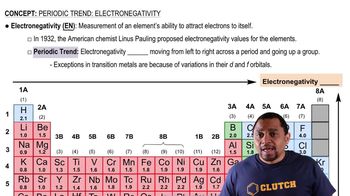
Electronegativity

Electronegativity is a measure of an atom's ability to attract and hold onto electrons in a bond. The difference in electronegativity between two atoms determines the type of bond formed: a large difference typically indicates ionic bonding, while a smaller difference suggests covalent bonding. This concept is crucial for predicting the polarity of molecules.
추천 영상:
가이드 코스
02:10
Electronegativity Trends

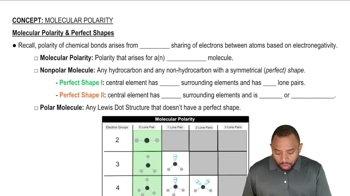
Polarity of Molecules

Polarity refers to the distribution of electrical charge over the atoms in a molecule. A molecule is polar if it has a significant difference in electronegativity between bonded atoms, leading to a dipole moment. Nonpolar molecules, on the other hand, have an even distribution of charge. Recognizing polarity is essential for understanding molecular interactions and properties.
추천 영상:
가이드 코스
02:38
Molecular Polarity