Ch.7 - Covalent Bonding and Electron-Dot Structures
McMurry - Chemistry 8th Edition
McMurry8th EditionChemistryISBN: 9781292336145당신이 사용하는 게 아니라요?교과서 변경
7장, 문제 60

The dipole moment of BrCl is 0.518 D, and the distance between atoms is 213.9 pm. What is the percent ionic char-acter of the BrCl bond?

검증된 단계별 안내
1
Convert the dipole moment from Debye (D) to Coulomb-meters (C·m) using the conversion factor: 1 D = 3.33564 × 10^{-30} C·m.
Convert the bond distance from picometers (pm) to meters (m) using the conversion factor: 1 pm = 1 × 10^{-12} m.
Calculate the theoretical dipole moment for a completely ionic bond using the formula: \( \mu_{ionic} = q \times d \), where \( q \) is the charge of an electron (1.602 × 10^{-19} C) and \( d \) is the bond distance in meters.
Determine the percent ionic character using the formula: \( \text{Percent Ionic Character} = \left( \frac{\mu_{observed}}{\mu_{ionic}} \right) \times 100 \% \), where \( \mu_{observed} \) is the dipole moment in C·m.
Substitute the values into the percent ionic character formula and simplify to find the percent ionic character of the BrCl bond.

비슷한 문제에 대한 검증된 영상 답변:

이 영상 해법은 위 문제에 도움이 된다고 튜터들이 추천한 것입니다.
영상 길이:
1m

주요 개념

질문에 올바르게 답하기 위해 반드시 이해해야 하는 핵심 개념들은 다음과 같습니다.

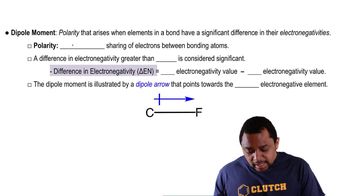
Dipole Moment

The dipole moment is a measure of the separation of positive and negative charges in a molecule, represented as a vector quantity. It is calculated as the product of the charge and the distance between the charges. In the context of BrCl, the dipole moment indicates the polarity of the bond, with a higher value suggesting a greater ionic character.
추천 영상:

Ionic Character

Ionic character refers to the extent to which a bond between two atoms exhibits ionic properties, as opposed to covalent properties. It is influenced by the difference in electronegativity between the bonded atoms. The percent ionic character can be estimated using the dipole moment and the bond length, providing insight into the bond's nature.
추천 영상:
가이드 코스
00:56
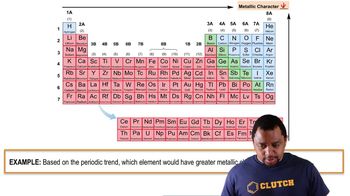
Metallic Character Example

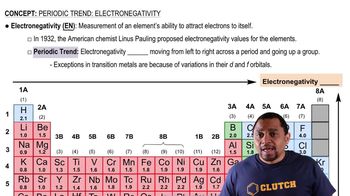
Electronegativity

Electronegativity is a measure of an atom's ability to attract and hold onto electrons in a chemical bond. The greater the difference in electronegativity between two bonded atoms, the more polar the bond becomes, leading to increased ionic character. Understanding electronegativity is crucial for predicting bond behavior and calculating ionic character in compounds like BrCl.
추천 영상:
가이드 코스
02:10
Electronegativity Trends