Ch.8 - Covalent Compounds: Bonding Theories and Molecular Structure
McMurry - Chemistry 8th Edition
McMurry8th EditionChemistryISBN: 9781292336145당신이 사용하는 게 아니라요?교과서 변경
8장, 문제 107c

Carbon monoxide is produced by incomplete combustion of fossil fuels. (c) What is the bond order of CO? Does this match the bond order predicted by the electron-dot structure?

검증된 단계별 안내
1
Step 1: To determine the bond order of a molecule, we need to know the molecular orbital diagram of the molecule. For CO, the molecular orbital diagram shows that there are 10 electrons in bonding orbitals and 2 electrons in antibonding orbitals.
Step 2: The bond order is calculated as the difference between the number of electrons in bonding and antibonding orbitals, divided by 2. So, for CO, the bond order is (10-2)/2 = 4.
Step 3: The electron-dot structure, also known as the Lewis structure, for CO shows a triple bond between the carbon and oxygen atoms. This suggests a bond order of 3.
Step 4: The discrepancy between the bond order calculated from the molecular orbital diagram (4) and the bond order predicted by the electron-dot structure (3) is due to the fact that the electron-dot structure does not take into account the presence of antibonding electrons.
Step 5: Therefore, while the electron-dot structure provides a useful approximation, the molecular orbital theory provides a more accurate description of the bonding in CO.

비슷한 문제에 대한 검증된 영상 답변:

이 영상 해법은 위 문제에 도움이 된다고 튜터들이 추천한 것입니다.
영상 길이:
6m

주요 개념

질문에 올바르게 답하기 위해 반드시 이해해야 하는 핵심 개념들은 다음과 같습니다.

Bond Order

Bond order is a measure of the number of chemical bonds between a pair of atoms. It is calculated as the difference between the number of bonding electrons and the number of antibonding electrons, divided by two. In the case of carbon monoxide (CO), the bond order can be determined from its molecular orbital configuration, indicating the strength and stability of the bond.
추천 영상:
가이드 코스
00:36
Average Bond Order

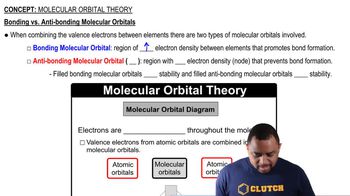
Molecular Orbital Theory

Molecular Orbital Theory describes the behavior of electrons in molecules, where atomic orbitals combine to form molecular orbitals that can be occupied by electrons. For CO, the molecular orbital diagram shows that the bond order is 3, indicating a triple bond between carbon and oxygen. This theory provides a more accurate representation of bonding compared to simple Lewis structures.
추천 영상:
가이드 코스
03:06
Molecular Orbital Theory

Electron-Dot Structure (Lewis Structure)

The electron-dot structure, or Lewis structure, represents the valence electrons of atoms within a molecule. For CO, the Lewis structure suggests a double bond between carbon and oxygen, which may not accurately reflect the actual bond order. This discrepancy highlights the limitations of Lewis structures in predicting molecular properties compared to molecular orbital theory.
추천 영상:
가이드 코스
04:28
Lewis Dot Structures: Ions