

Ch.8 - Covalent Compounds: Bonding Theories and Molecular Structure
McMurry - Chemistry 8th Edition
McMurry8th EditionChemistryISBN: 9781292336145당신이 사용하는 게 아니라요?교과서 변경
8장, 문제 33a

The following ball-and-stick molecular model is a representation of thalidomide, a drug that causes birth defects when taken by expectant mothers but is valuable for its use against leprosy. The lines indicate only the connections between atoms, not whether the bonds are single, double, or triple. 1Red = O, gray = C, blue = N, ivory = H.2 (a) What is the formula of thalidomide?

검증된 단계별 안내
1
Identify the colors representing each type of atom in the ball-and-stick model: Red for Oxygen (O), Gray for Carbon (C), Blue for Nitrogen (N), and Ivory for Hydrogen (H).
Count the number of each type of atom in the model. Carefully examine the model to ensure all atoms are accounted for.
Write down the chemical symbols for each type of atom, followed by the number of atoms of that type in the molecule. This will form the molecular formula.
Ensure that the molecular formula is written in the standard order: Carbon (C) first, followed by Hydrogen (H), and then the other elements in alphabetical order.
Double-check the counts and the order of elements to ensure the molecular formula accurately represents the model.

비슷한 문제에 대한 검증된 영상 답변:

이 영상 해법은 위 문제에 도움이 된다고 튜터들이 추천한 것입니다.
영상 길이:
2m
도움이 되었나요?

주요 개념

질문에 올바르게 답하기 위해 반드시 이해해야 하는 핵심 개념들은 다음과 같습니다.

Molecular Formula

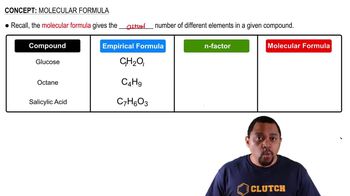
A molecular formula represents the number and types of atoms in a molecule. It is expressed using chemical symbols and subscripts, indicating how many of each atom are present. For example, the molecular formula for water is H2O, meaning it contains two hydrogen atoms and one oxygen atom. Understanding how to derive a molecular formula from a molecular model is essential for identifying the composition of a compound.
추천 영상:
가이드 코스
02:08
Determining Molecular Formulas

Chemical Structure

Chemical structure refers to the arrangement of atoms within a molecule, including the types of bonds (single, double, or triple) between them. In a ball-and-stick model, different colors represent different elements, and the sticks represent bonds. Recognizing the structure helps in understanding the properties and reactivity of the molecule, which is crucial for determining its formula and function.
추천 영상:
가이드 코스
03:31
Chemical Properties

Functional Groups

Functional groups are specific groups of atoms within molecules that are responsible for the characteristic chemical reactions of those molecules. In organic chemistry, common functional groups include hydroxyl (-OH), carboxyl (-COOH), and amine (-NH2) groups. Identifying functional groups in a compound like thalidomide can provide insights into its biological activity and potential effects, such as its teratogenic properties.
추천 영상:
가이드 코스
01:32
Carbonyl Functional Groups