


Ch.8 - Covalent Compounds: Bonding Theories and Molecular Structure
McMurry - Chemistry 8th Edition
McMurry8th EditionChemistryISBN: 9781292336145당신이 사용하는 게 아니라요?교과서 변경
8장, 문제 98

Use the MO energy diagram in Figure 8.22b to describe the bonding in O2+, O2, and O2-. Which of the three is likely to be stable? What is the bond order of each? Which contain unpaired electrons?

검증된 단계별 안내
1
Identify the molecular orbital (MO) energy diagram for O2, O2+, and O2-. This diagram will show the energy levels and the filling of the molecular orbitals with electrons for each molecule.
Determine the electron configuration for each species (O2+, O2, O2-) by filling the molecular orbitals according to the Aufbau principle, Hund's rule, and the Pauli exclusion principle. Start filling from the lowest energy orbital up to the highest that the molecule's electron count allows.
Calculate the bond order for each species using the formula: Bond Order = (Number of electrons in bonding orbitals - Number of electrons in antibonding orbitals) / 2. This will help determine the stability and the strength of the bond in each molecule.
Analyze the electron configurations to identify which species have unpaired electrons. Species with unpaired electrons are paramagnetic, while those with all paired electrons are diamagnetic.
Compare the bond orders and the presence of unpaired electrons to assess the relative stability of O2+, O2, and O2-. Generally, a higher bond order indicates a more stable molecule, and the presence of unpaired electrons can affect the molecule's reactivity and magnetic properties.

비슷한 문제에 대한 검증된 영상 답변:

이 영상 해법은 위 문제에 도움이 된다고 튜터들이 추천한 것입니다.
영상 길이:
12m

주요 개념

질문에 올바르게 답하기 위해 반드시 이해해야 하는 핵심 개념들은 다음과 같습니다.

Molecular Orbital Theory

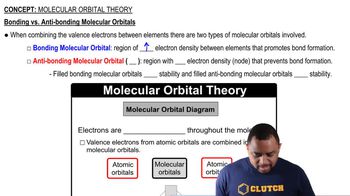
Molecular Orbital (MO) Theory describes how atomic orbitals combine to form molecular orbitals, which can be occupied by electrons. In this theory, electrons are delocalized over the entire molecule, and the energy levels of these orbitals determine the stability and bonding characteristics of the molecule. Understanding the arrangement of electrons in these orbitals is crucial for predicting bond order and magnetic properties.
추천 영상:
가이드 코스
03:06
Molecular Orbital Theory

Bond Order

Bond order is a measure of the number of chemical bonds between a pair of atoms, calculated as the difference between the number of bonding and antibonding electrons divided by two. A higher bond order indicates a stronger bond and greater stability of the molecule. For example, in diatomic oxygen (O2), the bond order is 2, indicating a double bond, while in O2+ and O2-, the bond orders will differ due to the addition or removal of electrons.
추천 영상:
가이드 코스
00:36
Average Bond Order

Unpaired Electrons and Stability

Unpaired electrons are electrons that occupy an orbital alone rather than in pairs, contributing to the magnetic properties of a molecule. Molecules with unpaired electrons are often paramagnetic and can be less stable than those with all electrons paired. In the context of O2, O2+, and O2-, identifying the presence of unpaired electrons helps determine their stability and reactivity, with O2 being the most stable due to its paired electron configuration.
추천 영상:
가이드 코스
02:04
Band of Stability: Electron Capture