Acetic acid (CH3CO2H), whose aqueous solutions are known as vinegar, is prepared by reaction of ethyl alcohol (CH3CH2OH) with oxygen: CH3CH2OH(l) + O2(g) → CH3CO2H(l) + H2O(l) Use the following data to calculate ∆H° in kilojoules for the reaction: ∆H°f [CH3CH2OH(l)] = -277.7 kJ/mol ∆H°f [CH3CO2H(l)] = -484.5 kJ/mol ∆H°f [H2O(l)] = -285.8 kJ/mol
검증된 단계별 안내
1
Identify the reaction for which you need to calculate the enthalpy change (\( \Delta H^\circ \)). The reaction is: \( \text{CH}_3\text{CH}_2\text{OH}(l) + \text{O}_2(g) \rightarrow \text{CH}_3\text{CO}_2\text{H}(l) + \text{H}_2\text{O}(l) \).
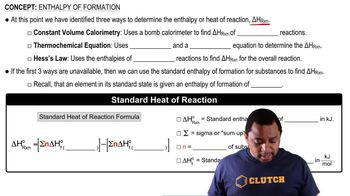
Use the formula for the standard enthalpy change of a reaction: \( \Delta H^\circ = \sum \Delta H^\circ_f(\text{products}) - \sum \Delta H^\circ_f(\text{reactants}) \).
List the standard enthalpy of formation (\( \Delta H^\circ_f \)) values for each substance involved: \( \Delta H^\circ_f [\text{CH}_3\text{CH}_2\text{OH}(l)] = -277.7 \text{ kJ/mol} \), \( \Delta H^\circ_f [\text{CH}_3\text{CO}_2\text{H}(l)] = -484.5 \text{ kJ/mol} \), \( \Delta H^\circ_f [\text{H}_2\text{O}(l)] = -285.8 \text{ kJ/mol} \).
Calculate the sum of the \( \Delta H^\circ_f \) values for the products: \( \Delta H^\circ_f [\text{CH}_3\text{CO}_2\text{H}(l)] + \Delta H^\circ_f [\text{H}_2\text{O}(l)] \).
Calculate the sum of the \( \Delta H^\circ_f \) values for the reactants: \( \Delta H^\circ_f [\text{CH}_3\text{CH}_2\text{OH}(l)] + \Delta H^\circ_f [\text{O}_2(g)] \). Note that the \( \Delta H^\circ_f \) for \( \text{O}_2(g) \) is 0 because it is in its standard state.
비슷한 문제에 대한 검증된 영상 답변:
이 영상 해법은 위 문제에 도움이 된다고 튜터들이 추천한 것입니다.
영상 길이:
5m
영상 재생:
0 댓글
주요 개념
질문에 올바르게 답하기 위해 반드시 이해해야 하는 핵심 개념들은 다음과 같습니다.
Enthalpy of Formation (∆H°f)
The enthalpy of formation (∆H°f) is the change in enthalpy when one mole of a compound is formed from its elements in their standard states. It is a crucial value in thermodynamics, allowing chemists to calculate the energy changes associated with chemical reactions. In this question, the ∆H°f values for the reactants and products are used to determine the overall enthalpy change for the reaction.
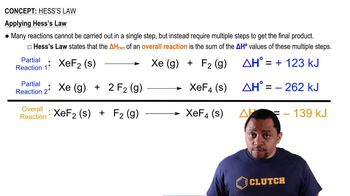
Hess's Law states that the total enthalpy change for a reaction is the sum of the enthalpy changes for the individual steps of the reaction, regardless of the pathway taken. This principle allows for the calculation of reaction enthalpies using standard enthalpy of formation values, as it simplifies the process of determining the heat change for complex reactions by breaking them down into simpler components.
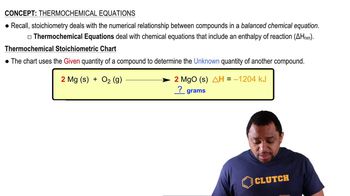
Thermochemical equations are balanced chemical equations that include the enthalpy change associated with the reaction. They provide a clear representation of the energy changes that occur during a reaction, allowing for the calculation of heat absorbed or released. In this context, the thermochemical equation for the reaction of ethyl alcohol with oxygen is essential for applying Hess's Law and calculating the overall ∆H°.


 검증된 단계별 안내
 02:34
02:34