Ethyl alcohol has ΔHfusion = 5.02 kJ/mol and melts at - 114.1 °C. What is the value of ΔSfusion for ethyl alcohol?
검증된 단계별 안내
1
Identify the formula to calculate the change in entropy (\( \Delta S \)) during the phase transition: \( \Delta S = \frac{\Delta H}{T} \).
Note that \( \Delta H_{\text{fusion}} \) is given as 5.02 kJ/mol.
Convert the melting point from Celsius to Kelvin by adding 273.15 to the Celsius temperature: \( T = -114.1 + 273.15 \).
Substitute the values of \( \Delta H_{\text{fusion}} \) and \( T \) (in Kelvin) into the formula: \( \Delta S = \frac{5.02 \text{ kJ/mol}}{T} \).
Ensure the units are consistent, typically converting \( \Delta H \) to J/mol if \( \Delta S \) is required in J/(mol·K).
비슷한 문제에 대한 검증된 영상 답변:
이 영상 해법은 위 문제에 도움이 된다고 튜터들이 추천한 것입니다.
영상 길이:
2m
영상 재생:
0 댓글
주요 개념
질문에 올바르게 답하기 위해 반드시 이해해야 하는 핵심 개념들은 다음과 같습니다.
Enthalpy of Fusion (ΔH<sub>fusion</sub>)
The enthalpy of fusion is the amount of energy required to change a substance from solid to liquid at its melting point. For ethyl alcohol, this value is given as 5.02 kJ/mol, indicating the energy needed to overcome intermolecular forces during the melting process.
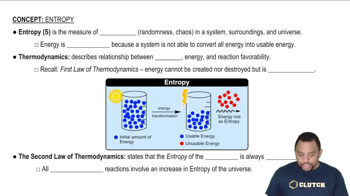
Entropy is a measure of the disorder or randomness in a system. When a solid melts into a liquid, the entropy increases because the molecules have more freedom to move. The change in entropy during fusion (ΔS<sub>fusion</sub>) can be calculated using the relationship between enthalpy and temperature.
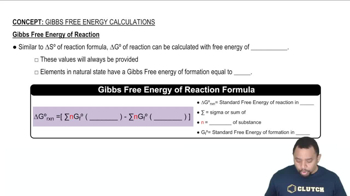
The Gibbs free energy change (ΔG) during a phase change can be expressed as ΔG = ΔH - TΔS. At equilibrium, such as at the melting point, ΔG is zero, allowing us to relate ΔH<sub>fusion</sub> and ΔS<sub>fusion</sub> to find the entropy change using the formula ΔS<sub>fusion</sub> = ΔH<sub>fusion</sub> / T, where T is the absolute temperature in Kelvin.


 검증된 단계별 안내
 03:17
03:17