Instant hot packs contain a solid and a pouch of water. When the pack is squeezed, the pouch breaks and the solid dis- solves, increasing the temperature because of the exothermic reaciton. The following reaction is used to make a hot pack: H2O
LiCl1s2 ¡ Li 1aq2 + Cl 1aq2 ∆H = -36.9 kJ. What is the final temperature in a squeezed hot pack that contains 25.0 g of LiCl dissolved# in 125 mL of water? Assume a specific heat of 4.18 J>1g °C2 for the solution, an initial temperature of 25.0 °C, and no heat transfer between the hot pack and the environment.
검증된 단계별 안내
1
Calculate the moles of LiCl using its molar mass. The molar mass of LiCl is approximately 42.39 g/mol.
Determine the total heat released by the reaction using the equation \( q = \Delta H \times \text{moles of LiCl} \). Remember that \( \Delta H \) is given as -36.9 kJ, so convert it to joules (1 kJ = 1000 J).
Calculate the total mass of the solution by adding the mass of water (125 mL of water is approximately 125 g, assuming the density of water is 1 g/mL) to the mass of LiCl (25.0 g).
Use the formula \( q = m \cdot c \cdot \Delta T \) to find the change in temperature (\( \Delta T \)), where \( q \) is the heat released, \( m \) is the total mass of the solution, and \( c \) is the specific heat capacity (4.18 J/g°C).
Calculate the final temperature by adding the change in temperature (\( \Delta T \)) to the initial temperature (25.0 °C).
비슷한 문제에 대한 검증된 영상 답변:
이 영상 해법은 위 문제에 도움이 된다고 튜터들이 추천한 것입니다.
영상 길이:
5m
영상 재생:
0 댓글
주요 개념
질문에 올바르게 답하기 위해 반드시 이해해야 하는 핵심 개념들은 다음과 같습니다.
Exothermic Reactions
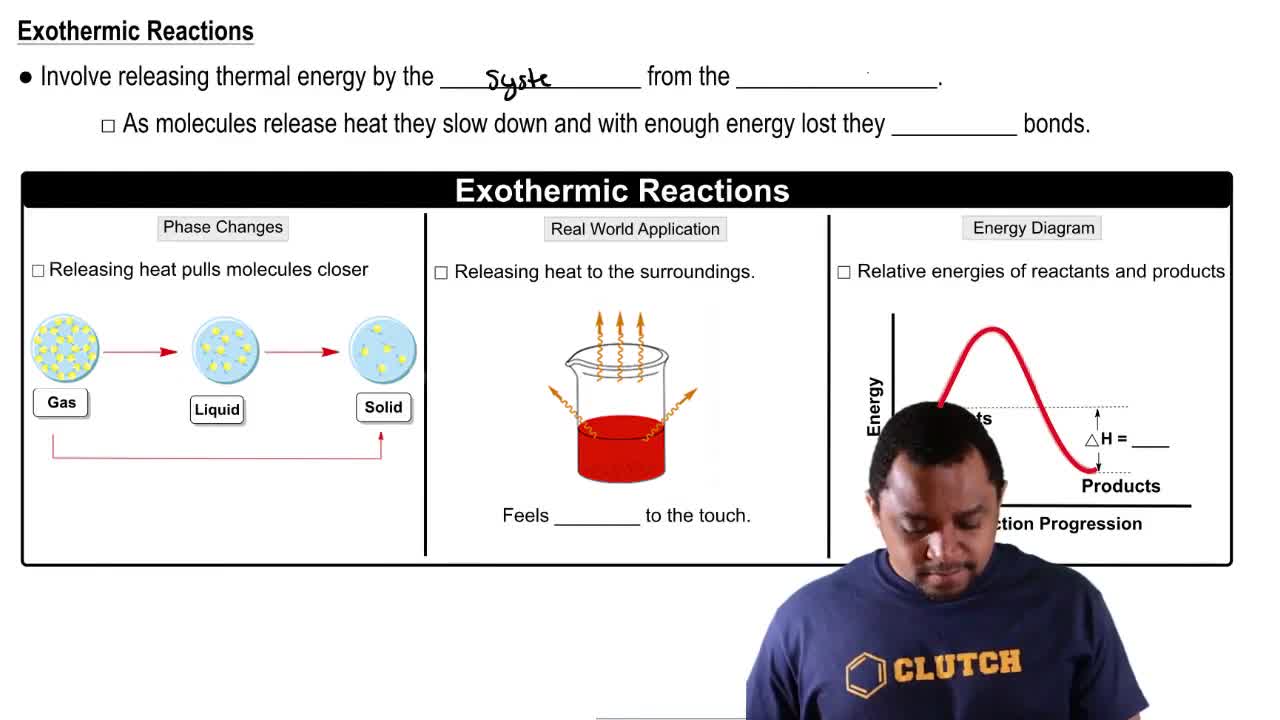
Exothermic reactions are chemical processes that release energy in the form of heat. In the context of the hot pack, the dissolution of LiCl in water is an exothermic reaction, which means that as the solid dissolves, it releases heat, causing the temperature of the solution to rise. This concept is crucial for understanding how the hot pack generates heat and increases in temperature.
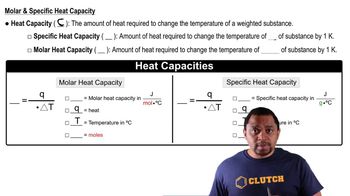
Specific heat capacity is the amount of heat required to raise the temperature of a unit mass of a substance by one degree Celsius. For the solution in the hot pack, the specific heat capacity is given as 4.18 J/g°C. This property is essential for calculating the temperature change of the solution when heat is added due to the dissolution of LiCl, allowing us to determine the final temperature of the hot pack.
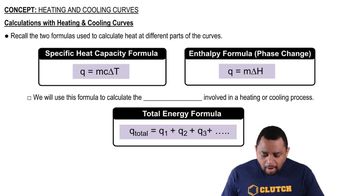
Heat transfer calculations involve determining the amount of heat absorbed or released during a chemical reaction or physical process. In this scenario, we can use the formula q = mcΔT, where q is the heat absorbed, m is the mass of the solution, c is the specific heat capacity, and ΔT is the change in temperature. This calculation is vital for finding the final temperature of the hot pack after the dissolution of LiCl.


 검증된 단계별 안내
 02:38
02:38