
Ch.9 - Thermochemistry: Chemical Energy
McMurry - Chemistry 8th Edition
McMurry8th EditionChemistryISBN: 9781292336145당신이 사용하는 게 아니라요?교과서 변경
9장, 문제 14

The boiling point of a substance is defined as the temperature at which liquid and vapor coexist in equilibrium. Use the heat of vaporization ΔHvap = 30.91 kJ/mol and the entropy of vaporization ΔSvap = 93.2 J/K·mol to calculate the boiling point (°C) of liquid bromine.

검증된 단계별 안내
1
Step 1: Understand the relationship between the boiling point, heat of vaporization (ΔHvap), and entropy of vaporization (ΔSvap). At the boiling point, the Gibbs free energy change (ΔG) for the phase transition is zero.
Step 2: Use the Gibbs free energy equation for phase transitions: ΔG = ΔHvap - TΔSvap. Set ΔG to zero because at the boiling point, the liquid and vapor are in equilibrium.
Step 3: Rearrange the equation to solve for the temperature (T): T = ΔHvap / ΔSvap.
Step 4: Convert the units of ΔHvap from kJ/mol to J/mol to match the units of ΔSvap. (1 kJ = 1000 J)
Step 5: Substitute the values of ΔHvap and ΔSvap into the equation to calculate the temperature in Kelvin, then convert the temperature from Kelvin to Celsius by subtracting 273.15.

주요 개념

질문에 올바르게 답하기 위해 반드시 이해해야 하는 핵심 개념들은 다음과 같습니다.

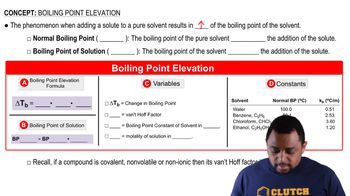
Boiling Point

The boiling point of a substance is the temperature at which its liquid phase transitions to the vapor phase, occurring when the vapor pressure equals the external pressure. At this point, the liquid and vapor coexist in equilibrium, meaning that the rate of evaporation equals the rate of condensation. Understanding this concept is crucial for calculating boiling points using thermodynamic properties.
추천 영상:
가이드 코스
03:05
Boiling Point Elevation

Heat of Vaporization (ΔHvap)

The heat of vaporization (ΔHvap) is the amount of energy required to convert one mole of a liquid into vapor at constant temperature and pressure. It is a critical factor in determining the boiling point, as higher ΔHvap values typically indicate stronger intermolecular forces, leading to higher boiling points. In this context, ΔHvap is given as 30.91 kJ/mol for bromine.
추천 영상:

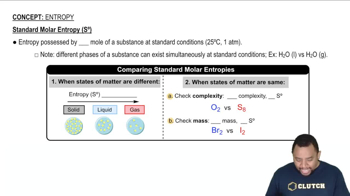
Entropy of Vaporization (ΔSvap)

The entropy of vaporization (ΔSvap) measures the change in disorder when a liquid transitions to a vapor. It is expressed in J/K·mol and reflects how much the molecular arrangement becomes more disordered during vaporization. This concept is essential for calculating the boiling point using the Gibbs free energy equation, which relates ΔHvap and ΔSvap to temperature.
추천 영상:
가이드 코스
03:33
Standard Molar Entropy
관련 실천
교과서 질문
Calculate the enthalpy change for the reaction C(s) + 2 H2(g) → CH4(g) ΔH = ? Given the enthalpy values for the following reactions CH4(g) + 2 O2(g) → CO2(g) + 2 H2O(l) ΔH = −890.4 kJ C(s) + O2(g) → CO2(g) ΔH = −393.5 kJ H2(g) + 1/2 O2(g) → H2O (g) ΔH = −285.8 kJ (a) −1569.7 kJ (b) +211.1 kJ (c) −1855.5 kJ (d) −74.7 kJ
4125
views
교과서 질문

Imagine a reaction that results in a change in both volume and temperature: (a) Has any work been done? If so, is its sign positive or negative?

390
views
교과서 질문
A piece of dry ice (solid CO2) is placed inside a balloon, and the balloon is tied shut. Over time, the carbon dioxide sub- limes, causing the balloon to increase in volume. Give the sign of the enthalpy change and the sign of work for the sublima- tion of CO2.
648
views
교과서 질문
A table of standard enthalpies of formation (ΔH°f) gives a value of −467.9 kJ/mol for NaNO3(s). Which reaction has a ΔH° value of −467.9 kJ? (a) Na+ (aq) + NO3−(aq) → NaNO3(s) (b) Na(s) + N(g + O3(g) → NaNO3(s) (c) Na(s) + 1/2 N2(g) + 3/2 O2(g) → NaNO3(s) (d) 2 Na(s) + N2(g) + 3 O2(g) → 2 NaNO3(s)
2474
views
교과서 질문
What is ΔH for the explosion of nitroglycerin? (LO 9.14) 2 C3H5(NO3)3(l) → 3 N2(g) + 1/2 O2(g) + 6 CO2(g) + 5 H2O(g) (a) −315.0 kJ (b) −4517 kJ (c) −3425 kJ (d) −3062 kJ
835
views