
Ch.9 - Thermochemistry: Chemical Energy
McMurry - Chemistry 8th Edition
McMurry8th EditionChemistryISBN: 9781292336145당신이 사용하는 게 아니라요?교과서 변경
9장, 문제 94

The industrial degreasing solvent methylene chloride, CH2Cl2, is prepared from methane by reaction with chlorine: CH4(g) + 2 Cl2(g) → CH2Cl2(g) + 2 HCl(g) Use the following data to calcualte ΔH° in kilojoules for the reaction: CH4(g) + Cl2(g) → CH3Cl(g) + HCl(g) ΔH° = -98.3 kJ CH3Cl(g) + Cl2(g) → CH2Cl2(g) + HCl(g) ΔH° = -104 kJ

검증된 단계별 안내
1
Identify the target reaction: CH4(g) + 2 Cl2(g) → CH2Cl2(g) + 2 HCl(g).
Notice that the target reaction can be seen as the sum of two given reactions: CH4(g) + Cl2(g) → CH3Cl(g) + HCl(g) and CH3Cl(g) + Cl2(g) → CH2Cl2(g) + HCl(g).
Write the given reactions and their enthalpy changes: 1) CH4(g) + Cl2(g) → CH3Cl(g) + HCl(g), ΔH° = -98.3 kJ; 2) CH3Cl(g) + Cl2(g) → CH2Cl2(g) + HCl(g), ΔH° = -104 kJ.
Add the two reactions together to obtain the target reaction: CH4(g) + 2 Cl2(g) → CH2Cl2(g) + 2 HCl(g).
Add the enthalpy changes of the two reactions to find the ΔH° for the target reaction: ΔH° = (-98.3 kJ) + (-104 kJ).

비슷한 문제에 대한 검증된 영상 답변:

이 영상 해법은 위 문제에 도움이 된다고 튜터들이 추천한 것입니다.
영상 길이:
3m

주요 개념

질문에 올바르게 답하기 위해 반드시 이해해야 하는 핵심 개념들은 다음과 같습니다.

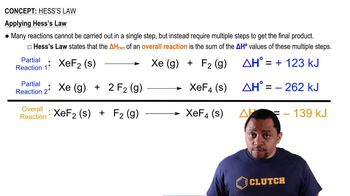
Hess's Law

Hess's Law states that the total enthalpy change for a chemical reaction is the sum of the enthalpy changes for the individual steps of the reaction, regardless of the pathway taken. This principle allows us to calculate the enthalpy change for a reaction that may not be directly measurable by using known enthalpy changes of related reactions.
추천 영상:

Enthalpy Change (ΔH°)

Enthalpy change (ΔH°) is a measure of the heat content of a system at constant pressure. It indicates whether a reaction is exothermic (releases heat, ΔH° < 0) or endothermic (absorbs heat, ΔH° > 0). Understanding ΔH° is crucial for predicting the energy changes associated with chemical reactions.
추천 영상:
가이드 코스
02:34
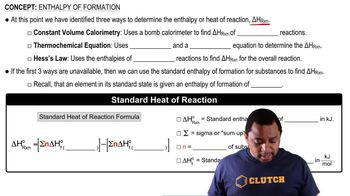
Enthalpy of Formation

Standard State Conditions

Standard state conditions refer to a set of specific conditions (usually 1 atm pressure and a specified temperature, typically 25°C) under which thermodynamic measurements are made. These conditions provide a reference point for comparing the enthalpy changes of different reactions, ensuring consistency in thermodynamic data.
추천 영상:
가이드 코스
01:10
Standard Reduction Potentials
관련 실천
교과서 질문
The following steps occur in the reaction of ethyl alcohol (CH3CH2OH) wiht oxygen to yield acetic acid (CH3CO2H). Show that equations 1 and 2 sum to give the net equation and calculate ΔH° for the net equation. (1) CH3CH2OH(l) + 1/2 O2(g) → CH3CHO (g) + H2O(l) ΔH° = -174.2 kJ (2) CH3CHO(g) + 1/2 O2(g) → CH3CO2H(l) ΔH° = -318.4 kJ (Net) CH3CH2OH(l) + O2(g) → CH3CO2H(l) + H2O(l) ΔH° = ?
685
views
교과서 질문
Set up a Hess's law cycle, and use the following information to calculate ΔH°f for aqueous nitiric acid, HNO3(aq). You will need to use fractional coefficients for some equations. 3 NO2(g) + H2O(l) → 2 HNO3(aq) + NO(g) ΔH° = -137.3 kJ 2 NO(g) + O2(g) → 2 NO2(g) ΔH° = -116.2 kJ 4 NH3(g) + 5 O2(g) → 4 NO (g) + 6 H2O(l) ΔH° = -1165.2 kJ NH3(g) ΔH°f = -46.1 kJ/mol H2O(l) ΔH°f = -285.8 kJ/mol
1206
views
교과서 질문
Hess's law can be used to calculate reaction enthalpies for hypothetical processes that can't be carried out in the labo- ratory. Set up a Hess's law cycle that will let you calculate ∆H° for the conversion of methane to ethylene: 2 CH4(g) → C2H4(g) + 2 H2(g) You can use the following information: 2 C2H6(g) + 7 O2(g) → 4 CO2(g) + 6 H2O(l) ∆H° = -3120.8 kJ CH4(g) + 2 O2(g) → CO2(g) + 2 H2O(l) ∆H° = -890.3 kJ C2H4(g) + H2(g) → C2H6(g) ∆H° = -136.3 kJ H2O(l) ∆H°f = -285.8 kJ/mol
1018
views
교과서 질문
Find ∆H° in kilojoules for the reaciton of nitric oxide with oxygen, 2 NO(g) + O2(g) → N2O4(g), given the following data: N2O4(g) → 2 NO2(g) ∆H° = 55.3 kJ NO(g) + 1/2 O2(g) → NO2(g) ∆H° = -58.1 kJ
970
views
교과서 질문
What is Hess's law, and why does it 'work'?
598
views
교과서 질문
Citric acid has three dissociable hydrogens. When 5.00 mL of 0.64 M citric acid and 45.00 mL of 0.77 M NaOH are mixed at an initial temperature of 26.0 °C, the temperature rises to 27.9 °C as the citric acid is neutralized. The combined mixture ahs a mass of 51.6 g and a specific heat of 4.0 J/(g·°C). Assuming that no heat is transferred to the surroundings, cal- culate the enthalpy change for the reaction of 1.00 mol of cit- ric acid in kJ. Is the reaction exothermic or endothermic?
630
views