Ch.1 - Matter, Measurement & Problem Solving
Tro - Chemistry: A Molecular Approach 4th Edition
Tro4th EditionChemistry: A Molecular ApproachISBN: 9780134112831당신이 사용하는 게 아니라요?교과서 변경
1장, 문제 87

Calculate to the correct number of significant figures. a. (24.6681 * 2.38) + 332.58 b. (85.3 - 21.489) , 0.0059 c. (512 , 986.7) + 5.44 d. [(28.7 * 105) , 48.533] + 144.99

검증된 단계별 안내
1
Step 1: For each operation, identify the number of significant figures in each number involved. For multiplication and division, the result should have the same number of significant figures as the number with the least significant figures in the operation. For addition and subtraction, the result should have the same number of decimal places as the number with the least decimal places.
Step 2: Perform the operations while keeping track of significant figures. For part a, multiply 24.6681 and 2.38 first, then add 332.58 to the product. For part b, subtract 21.489 from 85.3, then divide the result by 0.0059. For part c, divide 512 by 986.7, then add 5.44 to the quotient. For part d, multiply 28.7 by 105, divide the product by 48.533, and finally add 144.99 to the quotient.
Step 3: Round each intermediate and final result to the correct number of significant figures or decimal places as determined in Step 1.
Step 4: Ensure that the final answers are presented with the correct significant figures or decimal places, reflecting the precision of the least precise measurement used in the calculations.
Step 5: Review each calculation to confirm that the rules for significant figures have been consistently applied throughout the problem.

비슷한 문제에 대한 검증된 영상 답변:

이 영상 해법은 위 문제에 도움이 된다고 튜터들이 추천한 것입니다.
영상 길이:
1m
도움이 되었나요?

주요 개념

질문에 올바르게 답하기 위해 반드시 이해해야 하는 핵심 개념들은 다음과 같습니다.

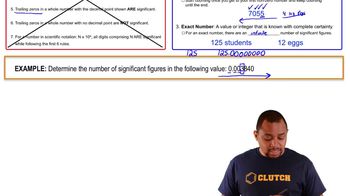
Significant Figures

Significant figures are the digits in a number that contribute to its precision. This includes all non-zero digits, any zeros between significant digits, and trailing zeros in the decimal portion. Understanding significant figures is crucial for accurately reporting measurements and calculations in chemistry, as it reflects the precision of the data used.
추천 영상:
가이드 코스
01:09
Significant Figures Example

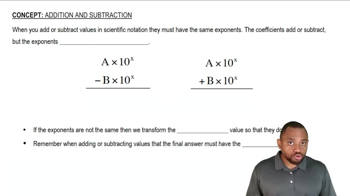
Rules for Addition and Subtraction

When performing addition or subtraction, the result should be reported with the same number of decimal places as the measurement with the least number of decimal places. This rule ensures that the precision of the result is not overstated, maintaining the integrity of the data derived from the calculations.
추천 영상:
가이드 코스
01:47
Scientific Notation in Addition and Substraction

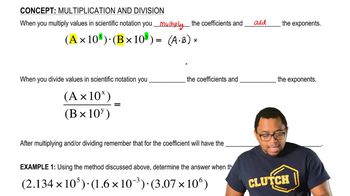
Rules for Multiplication and Division

For multiplication and division, the result should be reported with the same number of significant figures as the measurement that has the least number of significant figures. This rule is essential for maintaining the accuracy of calculated values, as it reflects the limitations of the least precise measurement involved in the calculation.
추천 영상:
가이드 코스
02:10
Scientific Notation in Multiplication and Division