Ch.1 - Matter, Measurement & Problem Solving
Tro - Chemistry: A Molecular Approach 4th Edition
Tro4th EditionChemistry: A Molecular ApproachISBN: 9780134112831당신이 사용하는 게 아니라요?교과서 변경
1장, 문제 134

Mercury is often used in thermometers. The mercury sits in a bulb on the bottom of the thermometer and rises up a thin capillary as the temperature rises. Suppose a mercury thermometer contains 3.380 g of mercury and has a capillary that is 0.200 mm in diameter. How far does the mercury rise in the capillary when the temperature changes from 0.0 °C to 25.0 °C? The density of mercury at these temperatures is 13.596 g/cm3 and 13.534 g/cm3, respectively

검증된 단계별 안내
1
Calculate the volume of mercury at 0.0 °C using the mass and density: \( V = \frac{m}{\rho} \).
Calculate the volume of mercury at 25.0 °C using the mass and density: \( V = \frac{m}{\rho} \).
Determine the change in volume of mercury by subtracting the initial volume from the final volume.
Calculate the cross-sectional area of the capillary using the formula for the area of a circle: \( A = \pi \left(\frac{d}{2}\right)^2 \), where \( d \) is the diameter.
Find the height the mercury rises by dividing the change in volume by the cross-sectional area: \( h = \frac{\Delta V}{A} \).

비슷한 문제에 대한 검증된 영상 답변:

이 영상 해법은 위 문제에 도움이 된다고 튜터들이 추천한 것입니다.
영상 길이:
7m
도움이 되었나요?

주요 개념

질문에 올바르게 답하기 위해 반드시 이해해야 하는 핵심 개념들은 다음과 같습니다.

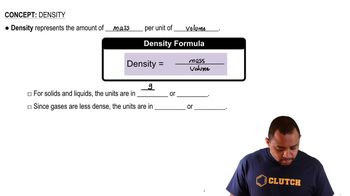
Density

Density is defined as mass per unit volume and is a crucial property of materials. In this context, the density of mercury at different temperatures is essential for calculating how much volume the mercury occupies when heated. The formula for density is ρ = m/V, where ρ is density, m is mass, and V is volume. Understanding how density changes with temperature helps predict the behavior of substances in response to thermal expansion.
추천 영상:
가이드 코스
01:56
Density Concepts

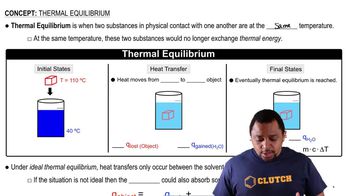
Thermal Expansion

Thermal expansion refers to the increase in volume of a substance as its temperature rises. In the case of mercury in a thermometer, as the temperature increases, the kinetic energy of the mercury atoms increases, causing them to occupy more space. This principle is fundamental to the operation of thermometers, as it allows the liquid to rise in the capillary tube, providing a visual indication of temperature changes.
추천 영상:
가이드 코스
02:35
Thermal Equilibrium

Capillary Action

Capillary action is the ability of a liquid to flow in narrow spaces without the assistance of external forces, due to intermolecular forces. In a thermometer, the narrow capillary tube allows mercury to rise as it expands with heat. This phenomenon is influenced by the adhesive forces between the liquid and the walls of the tube, as well as the cohesive forces within the liquid itself, making it essential for understanding how the mercury moves in response to temperature changes.
추천 영상:
가이드 코스
2:04
Intermolecular vs Intramolecular Example