Determine the molecular geometry and sketch each molecule or ion, using the bond conventions shown in 'Representing Molecular Geometries on Paper' in Section 10.4. c. PF5
Ch.10 - Chemical Bonding II: Molecular Shapes & Valence Bond Theory
10장, 문제 40b
Determine the molecular geometry and sketch each molecule or ion, using the bond conventions shown in 'Representing Molecular Geometries on Paper' in Section 10.4. b. SCl6
검증된 단계별 안내1
Determine the central atom: In SCl_6, sulfur (S) is the central atom because it is less electronegative than chlorine (Cl) and can form multiple bonds.
Count the total number of valence electrons: Sulfur has 6 valence electrons, and each chlorine has 7 valence electrons. Therefore, the total number of valence electrons is 6 + (6 * 7) = 48.
Apply the VSEPR theory: The molecule SCl_6 has 6 bonding pairs and no lone pairs around the central sulfur atom. According to VSEPR theory, this results in an octahedral molecular geometry.
Sketch the molecule: In an octahedral geometry, the central atom is surrounded by six atoms at 90-degree angles. Use solid lines for bonds in the plane of the paper, wedges for bonds coming out of the plane, and dashed lines for bonds going into the plane.
Verify the geometry: Ensure that the sketch reflects the octahedral shape, with all Cl atoms equidistant from the central S atom, confirming the molecular geometry.

비슷한 문제에 대한 검증된 영상 답변:
이 영상 해법은 위 문제에 도움이 된다고 튜터들이 추천한 것입니다.
영상 길이:
1m도움이 되었나요?
주요 개념
질문에 올바르게 답하기 위해 반드시 이해해야 하는 핵심 개념들은 다음과 같습니다.
Molecular Geometry
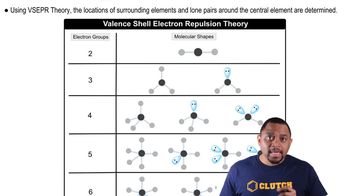
Molecular geometry refers to the three-dimensional arrangement of atoms within a molecule. It is determined by the number of bonding pairs and lone pairs of electrons around the central atom, which influences the shape of the molecule. Common geometries include linear, trigonal planar, tetrahedral, and octahedral, each corresponding to specific arrangements of electron pairs.
추천 영상:
가이드 코스
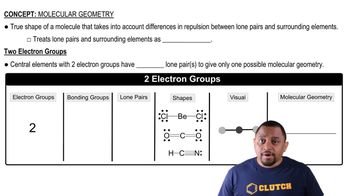
Molecular Geometry with Two Electron Groups
VSEPR Theory
Valence Shell Electron Pair Repulsion (VSEPR) theory is a model used to predict the geometry of molecules based on the repulsion between electron pairs in the valence shell of the central atom. According to VSEPR, electron pairs will arrange themselves to minimize repulsion, leading to specific molecular shapes. This theory is essential for determining the geometry of complex molecules like SCl6.
추천 영상:
가이드 코스
Molecular Shapes and VSEPR
Bonding and Lone Pairs
In molecular structures, bonding pairs are the pairs of electrons shared between atoms, while lone pairs are the pairs of valence electrons that are not involved in bonding. The presence of lone pairs can significantly affect the molecular geometry by altering bond angles and overall shape. Understanding the distribution of these pairs is crucial for accurately sketching molecular structures.
추천 영상:
가이드 코스
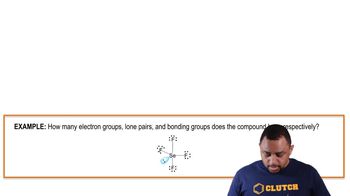
Electron Groups, Lone Pairs, and Bonding Groups Example
관련 실천
교과서 질문
458
views
교과서 질문
Determine the molecular geometry and sketch each molecule or ion using the bond conventions shown in 'Representing Molecular Geometries on Paper' in Section 10.4. c. IF2-
469
views
교과서 질문
Determine the molecular geometry and sketch each molecule or ion, using the bond conventions shown in 'Representing Molecular Geometries on Paper' in Section 10.4. d. IF4+
720
views
5
comments
교과서 질문
Determine the molecular geometry and sketch each molecule or ion using the bond conventions shown in 'Representing Molecular Geometries on Paper' in Section 10.4. d. IBr4-
778
views
교과서 질문
Determine the molecular geometry about each interior atom and draw each molecule. (Skeletal structure is indicated in parentheses.)
a. C2H2 (skeletal structure HCCH)
b. C2H4 (skeletal structure H2CCH2)
c. C2H6 (skeletal structure H3CCH3)
647
views