Ch.10 - Chemical Bonding II: Molecular Shapes & Valence Bond Theory
Tro - Chemistry: A Molecular Approach 4th Edition
Tro4th EditionChemistry: A Molecular ApproachISBN: 9780134112831당신이 사용하는 게 아니라요?교과서 변경
10장, 문제 47

Explain why CO2 and CCl4 are both nonpolar even though they contain polar bonds.

검증된 단계별 안내
1
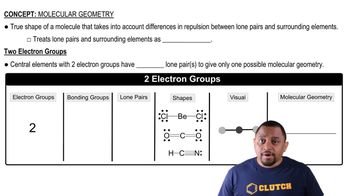
Identify the molecular geometry of CO2. Carbon dioxide has a linear molecular shape with the carbon atom in the center and oxygen atoms at both ends. The bond angles are 180 degrees.
Analyze the molecular geometry of CCl4. Carbon tetrachloride has a tetrahedral shape with the carbon atom in the center and four chlorine atoms at the corners. The bond angles are approximately 109.5 degrees.
Understand the concept of bond polarity. Both CO2 and CCl4 have polar bonds. In CO2, the difference in electronegativity between carbon and oxygen creates polar bonds. In CCl4, the difference in electronegativity between carbon and chlorine also results in polar bonds.
Examine the symmetry of the molecules. The symmetry of a molecule plays a crucial role in determining its overall polarity. In CO2, the linear shape and equal bond polarities pointing in opposite directions cancel each other out, resulting in a nonpolar molecule. In CCl4, the symmetrical tetrahedral shape with equal bond polarities directed toward the corners of a regular tetrahedron also results in cancellation of dipole moments, making the molecule nonpolar.
Conclude that despite containing polar bonds, the overall molecular polarity of CO2 and CCl4 is determined by their symmetrical geometric shapes, which allow the dipole moments to cancel out, resulting in nonpolar molecules.

비슷한 문제에 대한 검증된 영상 답변:

이 영상 해법은 위 문제에 도움이 된다고 튜터들이 추천한 것입니다.
영상 길이:
3m

주요 개념

질문에 올바르게 답하기 위해 반드시 이해해야 하는 핵심 개념들은 다음과 같습니다.

Polar and Nonpolar Bonds

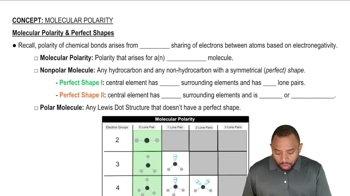
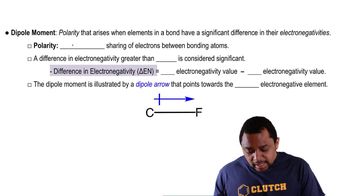
A polar bond occurs when there is a significant difference in electronegativity between the two atoms involved, leading to an uneven distribution of electron density. This results in a dipole moment, where one end of the bond is slightly negative and the other slightly positive. Nonpolar bonds, on the other hand, occur between atoms with similar electronegativities, resulting in an even distribution of electron density.
추천 영상:
가이드 코스
02:38
Molecular Polarity

Molecular Geometry

The shape of a molecule, determined by the arrangement of its atoms and the angles between bonds, plays a crucial role in its overall polarity. Even if a molecule contains polar bonds, its geometry can lead to a cancellation of dipole moments. For example, symmetrical molecules like CO2 and CCl4 have their polar bonds arranged in such a way that the dipoles cancel each other out, resulting in a nonpolar molecule.
추천 영상:
가이드 코스
01:33
Molecular Geometry with Two Electron Groups

Dipole Moment Cancellation

Dipole moment cancellation occurs when the individual dipole moments of polar bonds in a molecule are oriented in opposite directions and are equal in magnitude. This results in a net dipole moment of zero, making the molecule nonpolar. In CO2, the linear arrangement allows the dipoles to cancel, while in CCl4, the tetrahedral shape achieves the same effect, despite the presence of polar C-Cl bonds.
추천 영상: