Ch.10 - Chemical Bonding II: Molecular Shapes & Valence Bond Theory
Tro - Chemistry: A Molecular Approach 4th Edition
Tro4th EditionChemistry: A Molecular ApproachISBN: 9780134112831당신이 사용하는 게 아니라요?교과서 변경
10장, 문제 98

Indicate which orbitals overlap to form the s bonds in each compound. a. BeBr2 b. HgCl2 c. ICN

검증된 단계별 안내
1
Identify the type of hybridization for the central atom in each compound.
For BeBr2, recognize that beryllium (Be) typically forms sp hybrid orbitals, leading to the overlap of sp orbitals from Be with p orbitals from Br to form \( \sigma \) bonds.
For HgCl2, understand that mercury (Hg) can use its 6s orbital to overlap with the p orbitals of chlorine (Cl) to form \( \sigma \) bonds.
For ICN, identify that iodine (I) can use its p orbital to overlap with the p orbital of carbon (C) to form a \( \sigma \) bond, and carbon (C) can use its sp hybrid orbital to overlap with the p orbital of nitrogen (N) to form another \( \sigma \) bond.
Summarize the orbital overlaps: BeBr2 involves sp-p overlap, HgCl2 involves s-p overlap, and ICN involves p-p and sp-p overlaps.

비슷한 문제에 대한 검증된 영상 답변:

이 영상 해법은 위 문제에 도움이 된다고 튜터들이 추천한 것입니다.
영상 길이:
4m
도움이 되었나요?

주요 개념

질문에 올바르게 답하기 위해 반드시 이해해야 하는 핵심 개념들은 다음과 같습니다.

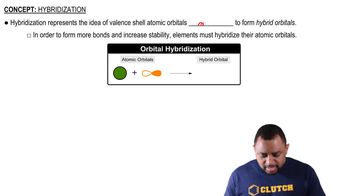
Orbital Hybridization

Orbital hybridization is the process by which atomic orbitals mix to form new hybrid orbitals that can accommodate bonding. In the context of s bonds, hybridization helps explain how atoms can form sigma bonds through the overlap of these hybrid orbitals, which are often a combination of s and p orbitals.
추천 영상:

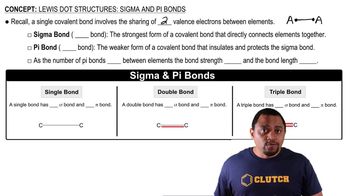
Sigma Bonds

Sigma bonds are the strongest type of covalent bond formed by the head-on overlap of atomic orbitals. They can be formed by the overlap of s-s, s-p, or p-p orbitals, and are characterized by a cylindrical symmetry around the bond axis. Understanding sigma bonds is crucial for determining the bonding structure in compounds.
추천 영상:
가이드 코스
03:26
Lewis Dot Structures: Sigma & Pi Bonds

Molecular Geometry

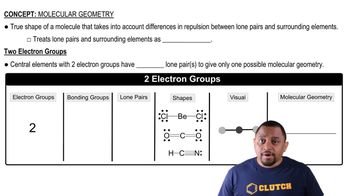
Molecular geometry refers to the three-dimensional arrangement of atoms within a molecule, which is influenced by the types of bonds and the hybridization of orbitals. The geometry helps predict the shape and reactivity of the molecule, which is essential for understanding how different orbitals overlap to form bonds in compounds like BeBr2, HgCl2, and ICN.
추천 영상:
가이드 코스
01:33
Molecular Geometry with Two Electron Groups