Ch.10 - Chemical Bonding II: Molecular Shapes & Valence Bond Theory
Tro - Chemistry: A Molecular Approach 4th Edition
Tro4th EditionChemistry: A Molecular ApproachISBN: 9780134112831당신이 사용하는 게 아니라요?교과서 변경
10장, 문제 89a

Most vitamins can be classified as either fat soluble, which results in their tendency to accumulate in the body (so that taking too much can be harmful), or water soluble, which results in their tendency to be quickly eliminated from the body in urine. Examine the structural formulas and space-filling models of these vitamins and determine whether each one is fat soluble (mostly nonpolar) or water soluble (mostly polar). (a) vitamin C

검증된 단계별 안내
1
Identify the structural formula of vitamin C, also known as ascorbic acid. Look for the presence of polar groups such as hydroxyl (OH) groups and the carboxyl (COOH) group.
Examine the overall structure to see if there are long nonpolar hydrocarbon chains or rings, which are characteristic of fat-soluble vitamins.
Assess the ratio of polar groups to nonpolar groups. A higher number of polar groups compared to nonpolar groups typically indicates water solubility.
Consider the molecular interactions vitamin C might have with water. Molecules with polar groups can form hydrogen bonds with water, enhancing solubility.
Conclude whether vitamin C is fat soluble or water soluble based on the predominance of polar or nonpolar groups in its structure.

비슷한 문제에 대한 검증된 영상 답변:

이 영상 해법은 위 문제에 도움이 된다고 튜터들이 추천한 것입니다.
영상 길이:
1m

주요 개념

질문에 올바르게 답하기 위해 반드시 이해해야 하는 핵심 개념들은 다음과 같습니다.

Solubility and Polarity

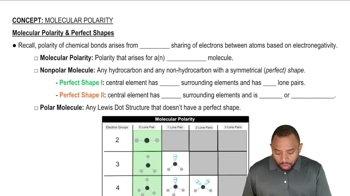
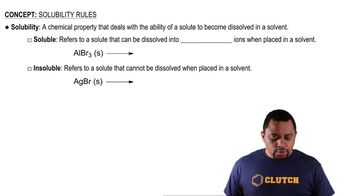
Solubility refers to the ability of a substance to dissolve in a solvent, which is influenced by the polarity of the molecules involved. Polar molecules, which have uneven distribution of charge, tend to dissolve well in water (a polar solvent), while nonpolar molecules, with even charge distribution, are more soluble in fats and oils. Understanding the polarity of vitamins is crucial for determining their solubility and how they behave in the body.
추천 영상:
가이드 코스
02:38
Molecular Polarity

Fat-Soluble vs. Water-Soluble Vitamins

Vitamins are categorized into two groups based on their solubility: fat-soluble vitamins (A, D, E, and K) can be stored in the body's fatty tissues and liver, while water-soluble vitamins (such as B-complex and C) are not stored and are excreted through urine. This classification affects their absorption, storage, and potential toxicity, making it essential to understand when evaluating vitamin intake.
추천 영상:
가이드 코스
02:07
Solubility and Insolubility

Structural Formulas and Space-Filling Models

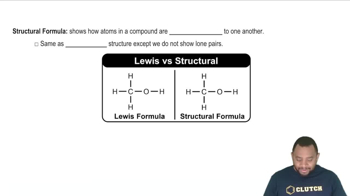
Structural formulas depict the arrangement of atoms within a molecule, while space-filling models provide a three-dimensional representation of the molecule's size and shape. Analyzing these models helps in understanding the molecular characteristics that influence a vitamin's solubility, such as the presence of polar functional groups or hydrophobic regions, which are key to determining whether a vitamin is fat-soluble or water-soluble.
추천 영상:
가이드 코스
01:00
Structural Formula