Ch.10 - Chemical Bonding II: Molecular Shapes & Valence Bond Theory
Tro - Chemistry: A Molecular Approach 4th Edition
Tro4th EditionChemistry: A Molecular ApproachISBN: 9780134112831당신이 사용하는 게 아니라요?교과서 변경
10장, 문제 7

Sketch the antibonding molecular orbital that results from the linear combination of two 1s orbitals. Indicate the region where interference occurs and state the type of interference (constructive or destructive).

검증된 단계별 안내
1
Start by considering two hydrogen atoms, each with a 1s atomic orbital, coming together to form a molecule.
When these 1s orbitals overlap, they can combine in two ways: constructively or destructively.
For the antibonding molecular orbital, focus on the destructive interference, where the wave functions of the two 1s orbitals have opposite signs.
Sketch the antibonding molecular orbital as having a node between the nuclei, where the electron density is zero due to destructive interference.
Label the region between the nuclei as the area of destructive interference, indicating that this is where the electron density is reduced, leading to the antibonding character.

주요 개념

질문에 올바르게 답하기 위해 반드시 이해해야 하는 핵심 개념들은 다음과 같습니다.

Molecular Orbitals

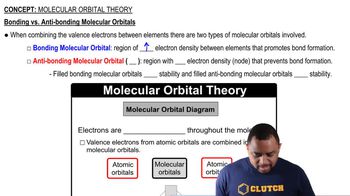
Molecular orbitals (MOs) are formed when atomic orbitals combine through linear combinations. In the case of two 1s orbitals, they can combine to form a bonding molecular orbital, which is lower in energy, and an antibonding molecular orbital, which is higher in energy. The antibonding orbital is characterized by a node between the two nuclei, indicating a region of zero electron density.
추천 영상:
가이드 코스
03:06
Molecular Orbital Theory

Interference of Waves

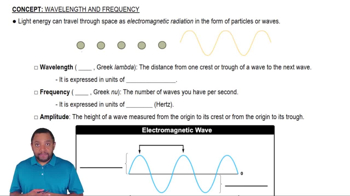
Interference refers to the phenomenon where two or more waves superimpose to form a resultant wave. In molecular orbital theory, when two atomic orbitals combine, they can interfere either constructively, leading to increased electron density (bonding), or destructively, leading to decreased electron density (antibonding). The antibonding molecular orbital results from destructive interference, where the wave functions of the two orbitals cancel each other out in certain regions.
추천 영상:
가이드 코스
2:58
Electromagnetic Waves

Nodes in Molecular Orbitals

A node is a region in a molecular orbital where the probability of finding an electron is zero. In the case of antibonding molecular orbitals, there is at least one node between the two nuclei, which signifies that the electron density is minimized in that area. This characteristic is crucial for understanding the stability and energy of molecular orbitals, as the presence of nodes typically indicates higher energy and less stability compared to bonding orbitals.
추천 영상:
가이드 코스
03:06
Molecular Orbital Theory