Ch.10 - Chemical Bonding II: Molecular Shapes & Valence Bond Theory
Tro - Chemistry: A Molecular Approach 4th Edition
Tro4th EditionChemistry: A Molecular ApproachISBN: 9780134112831당신이 사용하는 게 아니라요?교과서 변경
10장, 문제 69

Sketch the bonding molecular orbital that results from the linear combination of two 1s orbitals. Indicate the region where interference occurs and state the kind of interference (constructive or destructive).

검증된 단계별 안내
1
Identify the two 1s atomic orbitals that will combine. Each 1s orbital is spherically symmetrical around the nucleus of an atom.
Understand that when these orbitals overlap, they can do so in two ways: constructively (in-phase combination) or destructively (out-of-phase combination).
For constructive interference, the wave functions of the two 1s orbitals add together, leading to an increase in electron density between the nuclei. This is the bonding molecular orbital.
Sketch the bonding molecular orbital: Draw two overlapping circles (representing the 1s orbitals) with the overlap area shaded more heavily to indicate increased electron density.
Indicate the region of constructive interference, which is the area where the two orbitals overlap. Label this region as the area of constructive interference, which is responsible for the bonding character of the molecular orbital.

비슷한 문제에 대한 검증된 영상 답변:

이 영상 해법은 위 문제에 도움이 된다고 튜터들이 추천한 것입니다.
영상 길이:
1m
도움이 되었나요?

주요 개념

질문에 올바르게 답하기 위해 반드시 이해해야 하는 핵심 개념들은 다음과 같습니다.

Molecular Orbital Theory

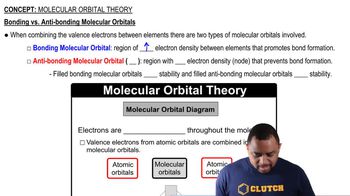
Molecular Orbital Theory describes how atomic orbitals combine to form molecular orbitals, which can be occupied by electrons in a molecule. When two atomic orbitals, such as 1s orbitals from two hydrogen atoms, combine, they can form two types of molecular orbitals: bonding and antibonding. The bonding molecular orbital is lower in energy and stabilizes the molecule, while the antibonding orbital is higher in energy and can destabilize it.
추천 영상:
가이드 코스
03:06
Molecular Orbital Theory

Linear Combination of Atomic Orbitals (LCAO)

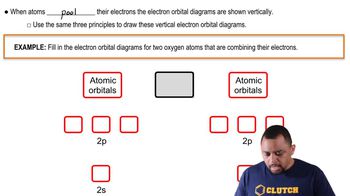
The Linear Combination of Atomic Orbitals (LCAO) is a method used to construct molecular orbitals by combining the wave functions of atomic orbitals. In the case of two 1s orbitals, the LCAO results in a bonding molecular orbital formed by the addition of the two wave functions, leading to a region of increased electron density between the nuclei. This combination can also produce an antibonding orbital through subtraction of the wave functions.
추천 영상:
가이드 코스
01:51
Atomic Orbitals Example

Interference of Waves

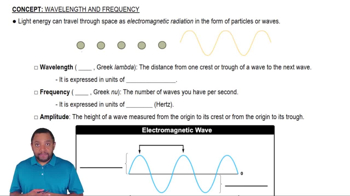
Interference of waves occurs when two or more wave functions overlap, leading to regions of constructive or destructive interference. Constructive interference happens when wave peaks align, resulting in increased amplitude, while destructive interference occurs when a peak aligns with a trough, leading to reduced amplitude. In the context of molecular orbitals, constructive interference in the bonding orbital enhances electron density between the nuclei, while destructive interference in the antibonding orbital reduces it.
추천 영상:
가이드 코스
2:58
Electromagnetic Waves