Ch.10 - Chemical Bonding II: Molecular Shapes & Valence Bond Theory
Tro - Chemistry: A Molecular Approach 4th Edition
Tro4th EditionChemistry: A Molecular ApproachISBN: 9780134112831당신이 사용하는 게 아니라요?교과서 변경
10장, 문제 56

Write orbital diagrams (boxes with arrows in them) to represent the electron configurations—without hybridization—for all the atoms in SF2. Circle the electrons involved in bonding. Draw a three-dimensional sketch of the molecule and show orbital overlap. What bond angle do you expect from the unhybridized orbitals? How well does valence bond theory agree with the experimentally measured bond angle of 98.2° ?

검증된 단계별 안내
1
Identify the electron configurations for sulfur (S) and fluorine (F). Sulfur has an atomic number of 16, so its electron configuration is 1s² 2s² 2p⁶ 3s² 3p⁴. Fluorine, with an atomic number of 9, has the electron configuration 1s² 2s² 2p⁵.
Draw the orbital diagrams for sulfur and fluorine. For sulfur, fill the 1s, 2s, and 2p orbitals completely, and place four electrons in the 3p orbital. For fluorine, fill the 1s, 2s orbitals completely, and place five electrons in the 2p orbital. Use arrows to represent electrons, with up and down arrows indicating opposite spins.
Circle the electrons in the outermost orbitals of sulfur and fluorine that are involved in bonding. In sulfur, this will be the two unpaired electrons in the 3p orbital. In fluorine, it will be one unpaired electron in the 2p orbital.
Draw a three-dimensional sketch of the SF2 molecule. Show sulfur at the center with two fluorine atoms bonded to it. Indicate the overlap of the unpaired electrons in the sulfur 3p orbitals with the unpaired electrons in the fluorine 2p orbitals to form sigma bonds.
Discuss the expected bond angle in SF2 based on the p-orbital overlap in the valence bond theory, which would predict angles close to 90° due to the p-orbital orientations. Compare this with the experimentally measured bond angle of 98.2°, and explain that the slight deviation might be due to factors like lone pair repulsion affecting the bond angles.

비슷한 문제에 대한 검증된 영상 답변:

이 영상 해법은 위 문제에 도움이 된다고 튜터들이 추천한 것입니다.
영상 길이:
4m

주요 개념

질문에 올바르게 답하기 위해 반드시 이해해야 하는 핵심 개념들은 다음과 같습니다.

Orbital Diagrams

Orbital diagrams visually represent the distribution of electrons in an atom's orbitals. Each box corresponds to an orbital, and arrows indicate the presence of electrons, with their direction showing spin. These diagrams help in understanding electron configurations and the pairing of electrons, which is crucial for predicting bonding behavior in molecules.
추천 영상:
가이드 코스
01:16
Electron Orbital Diagrams

Valence Bond Theory

Valence Bond Theory (VBT) explains how atoms bond by overlapping their atomic orbitals to form covalent bonds. It emphasizes the role of unhybridized orbitals in determining molecular geometry and bond angles. In the case of SF2, VBT can be used to predict the bond angle based on the arrangement of the unhybridized orbitals, which is essential for comparing theoretical predictions with experimental data.
추천 영상:
가이드 코스
00:47
Valence Shell Electron Pair Repulsion Theory

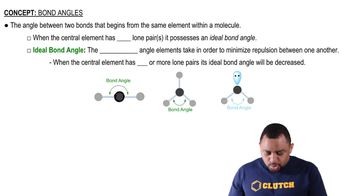
Bond Angles and Molecular Geometry

Bond angles are the angles between adjacent bonds in a molecule, which are influenced by the arrangement of electron pairs around a central atom. In SF2, the expected bond angle is affected by the presence of lone pairs and the repulsion between bonding and non-bonding electron pairs. Understanding these angles is crucial for predicting molecular shape and comparing theoretical predictions with experimental measurements.
추천 영상: