Ch.11 - Liquids, Solids & Intermolecular Forces
Tro - Chemistry: A Molecular Approach 4th Edition
Tro4th EditionChemistry: A Molecular ApproachISBN: 9780134112831당신이 사용하는 게 아니라요?교과서 변경
11장, 문제 92

Draw a heating curve (such as the one in Figure 11.36) for 1 mol of benzene beginning at 0 °C and ending at 100 °C. Assume that the values given here are constant over the relevant temperature ranges: Melting point 5.4 °C, Boiling point 80.1 °C, ΔHfus 9.9 kJ/mol, ΔHvap 30.7 kJ/mol, Cs,solid 118 J/mol⋅K, Cs,liquid 135 J/mol⋅K, Cs,gas 104 J/mol⋅K.

검증된 단계별 안내
1
Identify the key points on the heating curve: the melting point at 5.4 °C and the boiling point at 80.1 °C.
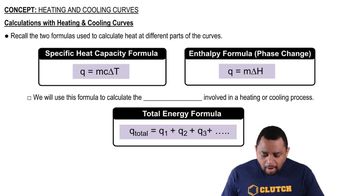
Calculate the energy required to heat the solid benzene from 0 °C to its melting point using the formula: \( q = m \cdot C_{s,solid} \cdot \Delta T \), where \( m \) is the number of moles, \( C_{s,solid} \) is the specific heat capacity of solid benzene, and \( \Delta T \) is the temperature change.
Calculate the energy required for the phase change from solid to liquid at the melting point using the formula: \( q = m \cdot \Delta H_{fus} \), where \( \Delta H_{fus} \) is the enthalpy of fusion.
Calculate the energy required to heat the liquid benzene from its melting point to its boiling point using the formula: \( q = m \cdot C_{s,liquid} \cdot \Delta T \).
Calculate the energy required for the phase change from liquid to gas at the boiling point using the formula: \( q = m \cdot \Delta H_{vap} \), where \( \Delta H_{vap} \) is the enthalpy of vaporization.

주요 개념

질문에 올바르게 답하기 위해 반드시 이해해야 하는 핵심 개념들은 다음과 같습니다.

Heating Curve

A heating curve is a graphical representation that shows the temperature change of a substance as it is heated over time. It illustrates phase changes, such as melting and boiling, where temperature remains constant despite the addition of heat. The curve typically consists of flat sections (phase changes) and sloped sections (temperature increases), allowing for the visualization of energy absorption and temperature variation across different states of matter.
추천 영상:
가이드 코스
01:05
Calculations with Heating and Cooling Curves

Phase Changes

Phase changes refer to the transitions between solid, liquid, and gas states of a substance, which occur at specific temperatures and pressures. For benzene, the melting point (5.4 °C) indicates the transition from solid to liquid, while the boiling point (80.1 °C) marks the change from liquid to gas. During these transitions, the temperature remains constant as energy is used to overcome intermolecular forces rather than increase kinetic energy.
추천 영상:
가이드 코스
01:46
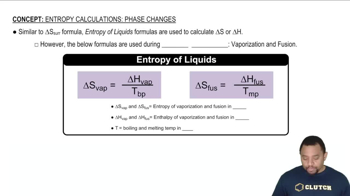
Entropy in Phase Changes

Enthalpy of Fusion and Vaporization

The enthalpy of fusion (ΔHfus) and enthalpy of vaporization (ΔHvap) are measures of the energy required to change a substance from solid to liquid and from liquid to gas, respectively. For benzene, ΔHfus is 9.9 kJ/mol and ΔHvap is 30.7 kJ/mol. These values are crucial for calculating the total energy required during the heating process, particularly during phase changes where temperature does not change but energy is absorbed.
추천 영상:
가이드 코스
01:37
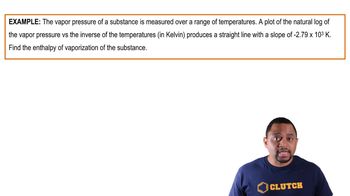
Enthalpy of Vaporization Example