
Ch.11 - Liquids, Solids & Intermolecular Forces
Tro - Chemistry: A Molecular Approach 4th Edition
Tro4th EditionChemistry: A Molecular ApproachISBN: 9780134112831당신이 사용하는 게 아니라요?교과서 변경
11장, 문제 72

How much heat (in kJ) is evolved in converting 1.00 mol of steam at 145 °C to ice at -50 °C? The heat capacity of steam is 2.01 J/g°C, and that of ice is 2.09 J/g°C.

검증된 단계별 안내
1
Calculate the heat lost by steam as it cools from 145 °C to 100 °C using q = m * C * ΔT, where m is the mass of steam, C is the heat capacity of steam, and ΔT is the change in temperature.
Determine the heat released during the phase change from steam to liquid water at 100 °C using q = n * ΔH_vap, where n is the number of moles and ΔH_vap is the enthalpy of vaporization.
Calculate the heat lost by water as it cools from 100 °C to 0 °C using q = m * C * ΔT, where C is the heat capacity of liquid water.
Determine the heat released during the phase change from liquid water to ice at 0 °C using q = n * ΔH_fus, where ΔH_fus is the enthalpy of fusion.
Calculate the heat lost by ice as it cools from 0 °C to -50 °C using q = m * C * ΔT, where C is the heat capacity of ice.

주요 개념

질문에 올바르게 답하기 위해 반드시 이해해야 하는 핵심 개념들은 다음과 같습니다.

Phase Changes and Heat Transfer

Phase changes, such as the conversion of steam to ice, involve significant heat transfer. During these transitions, heat is either absorbed or released, depending on whether a substance is melting, freezing, boiling, or condensing. Understanding the latent heat of fusion and vaporization is crucial for calculating the total heat evolved in such processes.
추천 영상:
가이드 코스
01:46
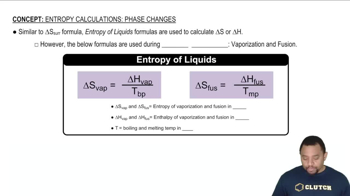
Entropy in Phase Changes

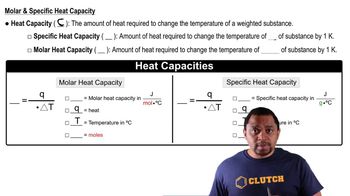
Specific Heat Capacity

Specific heat capacity is the amount of heat required to raise the temperature of a unit mass of a substance by one degree Celsius. It varies for different states of matter (solid, liquid, gas) and is essential for calculating the heat changes associated with temperature changes in a substance. In this question, the specific heat capacities of steam and ice are used to determine the heat lost or gained during temperature changes.
추천 영상:

Thermodynamic Calculations

Thermodynamic calculations involve using formulas to quantify heat transfer in chemical processes. The total heat evolved can be calculated by summing the heat changes from temperature adjustments and phase changes. This requires applying the equations Q = mcΔT for temperature changes and Q = nΔH for phase changes, where Q is heat, m is mass, c is specific heat, n is moles, and ΔH is the enthalpy change.
추천 영상:
가이드 코스
01:18
First Law of Thermodynamics