Ch.11 - Liquids, Solids & Intermolecular Forces
Tro - Chemistry: A Molecular Approach 4th Edition
Tro4th EditionChemistry: A Molecular ApproachISBN: 9780134112831당신이 사용하는 게 아니라요?교과서 변경
11장, 문제 80

Water is a good solvent for many substances. What is the molecular basis for this property, and why is it significant?

검증된 단계별 안내
1
Understand the molecular structure of water: Water (H2O) has a bent molecular shape with an angle of about 104.5 degrees between the hydrogen atoms. This shape leads to an uneven distribution of electron density, making water a polar molecule.
Recognize the importance of water's polarity: The polarity of water molecules allows them to form hydrogen bonds with other polar molecules and ions. This ability to form multiple hydrogen bonds makes water an effective solvent for many substances.
Explore the concept of 'like dissolves like': Polar solvents, such as water, are more effective at dissolving polar substances due to the interaction between polar molecules. This interaction involves the attraction between the positive and negative ends of the polar molecules.
Consider the significance of water's solvent properties: Water's ability to dissolve a wide range of substances is crucial for biological processes. For example, it allows for the transport of nutrients and waste products in living organisms and facilitates biochemical reactions.
Reflect on the environmental and chemical implications: The solvent properties of water also play a key role in environmental processes, such as the distribution of pollutants and the cycling of nutrients. In industrial and laboratory settings, water is used as a solvent in many chemical reactions and processes.

비슷한 문제에 대한 검증된 영상 답변:

이 영상 해법은 위 문제에 도움이 된다고 튜터들이 추천한 것입니다.
영상 길이:
1m
도움이 되었나요?

주요 개념

질문에 올바르게 답하기 위해 반드시 이해해야 하는 핵심 개념들은 다음과 같습니다.

Polarity of Water

Water is a polar molecule, meaning it has a partial positive charge on one side (hydrogens) and a partial negative charge on the other (oxygen). This polarity allows water to interact with various ionic and polar substances, effectively surrounding and separating their molecules, which is essential for dissolving them.
추천 영상:
가이드 코스
02:38
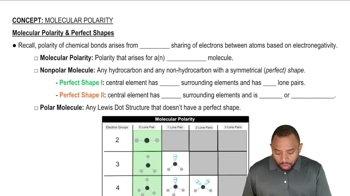
Molecular Polarity

Hydrogen Bonding

The polarity of water leads to hydrogen bonding, where the positive hydrogen atoms of one water molecule are attracted to the negative oxygen atoms of another. This strong intermolecular force contributes to water's high boiling point and its ability to dissolve many substances, making it an excellent solvent.
추천 영상:
가이드 코스
01:22
Hydrogenation Reactions

Solvation Process

Solvation is the process by which solvent molecules surround and interact with solute particles. In water, this involves the formation of hydration shells around ions or polar molecules, which stabilizes them in solution and facilitates chemical reactions, highlighting water's role in biological and chemical systems.
추천 영상:
가이드 코스
04:20
Spontaneity of Processes