Ch.11 - Liquids, Solids & Intermolecular Forces
Tro - Chemistry: A Molecular Approach 4th Edition
Tro4th EditionChemistry: A Molecular ApproachISBN: 9780134112831당신이 사용하는 게 아니라요?교과서 변경
11장, 문제 52

When a thin glass tube is put into water, the water rises 1.4 cm. When the same tube is put into hexane, the hexane rises only 0.4 cm. Explain.

검증된 단계별 안내
1
insert step 1> The phenomenon observed is known as capillary action, which is the ability of a liquid to flow in narrow spaces without the assistance of external forces like gravity. This is due to the adhesive forces between the liquid and the walls of the tube being stronger than the cohesive forces within the liquid.
insert step 2> Water has strong adhesive forces with glass due to hydrogen bonding. The polar nature of water molecules allows them to form hydrogen bonds with the polar surface of the glass, causing the water to rise higher in the tube.
insert step 3> Hexane, on the other hand, is a non-polar solvent. It does not form hydrogen bonds with the glass surface, resulting in weaker adhesive forces compared to water. This is why hexane rises to a lesser extent in the same tube.
insert step 4> The height to which a liquid rises in a capillary tube is also influenced by the surface tension of the liquid. Water has a higher surface tension than hexane, contributing to its greater rise in the tube.
insert step 5> The difference in rise between water and hexane in the glass tube can be attributed to the differences in their adhesive interactions with the glass and their respective surface tensions.

비슷한 문제에 대한 검증된 영상 답변:

이 영상 해법은 위 문제에 도움이 된다고 튜터들이 추천한 것입니다.
영상 길이:
1m
도움이 되었나요?

주요 개념

질문에 올바르게 답하기 위해 반드시 이해해야 하는 핵심 개념들은 다음과 같습니다.

Capillarity

Capillarity, or capillary action, is the ability of a liquid to flow in narrow spaces without the assistance of external forces. This phenomenon occurs due to the adhesive forces between the liquid and the solid surface of the tube, as well as the cohesive forces within the liquid itself. In this case, water exhibits strong adhesive forces with glass, leading to a higher rise compared to hexane.
추천 영상:
가이드 코스
2:04
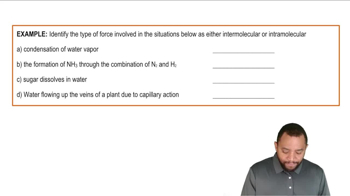
Intermolecular vs Intramolecular Example

Surface Tension

Surface tension is the property of a liquid that causes it to behave as if its surface is covered with a stretched elastic membrane. It arises from the cohesive forces between liquid molecules. Water has a high surface tension due to strong hydrogen bonding, which contributes to its ability to rise higher in the glass tube compared to hexane, which has weaker intermolecular forces.
추천 영상:
가이드 코스
03:13
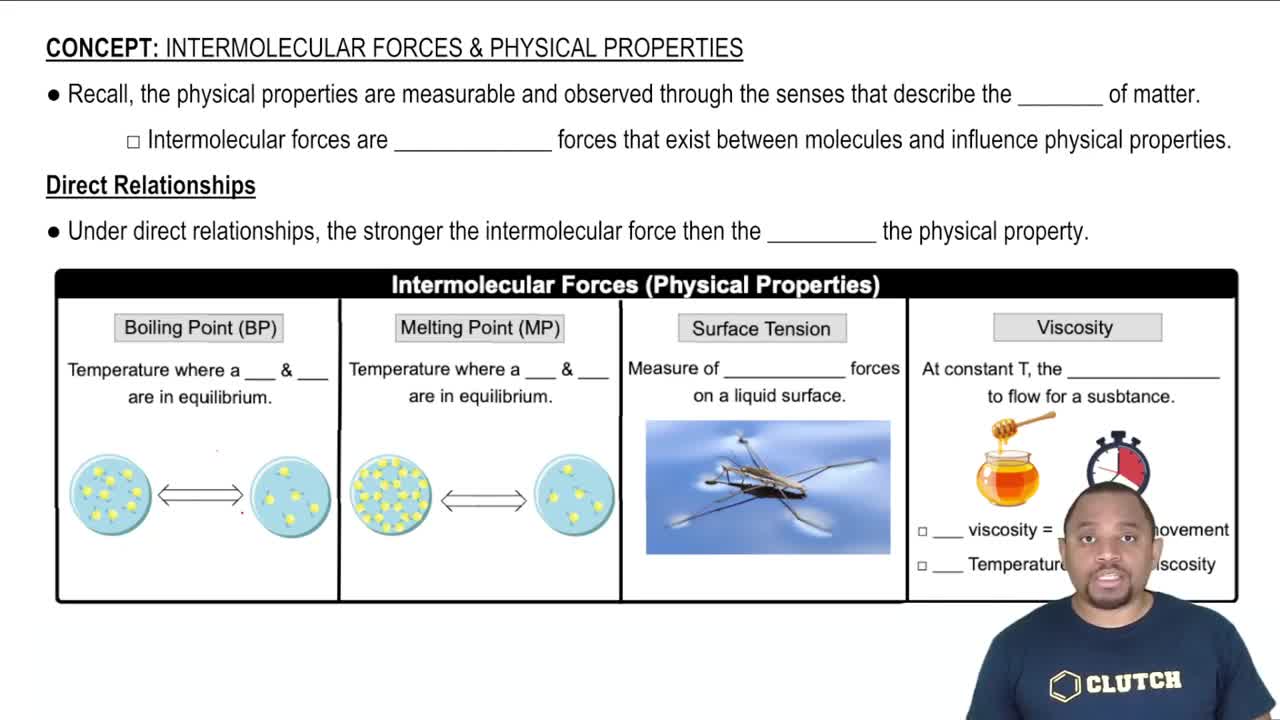
Intermolecular Forces and Properties

Intermolecular Forces

Intermolecular forces are the forces of attraction or repulsion between neighboring particles (atoms, molecules, or ions). These forces significantly influence the physical properties of substances, including their boiling points, melting points, and capillary action. Water, with its strong hydrogen bonds, has greater intermolecular forces than hexane, resulting in a more pronounced capillary rise in the glass tube.
추천 영상:
가이드 코스
01:59
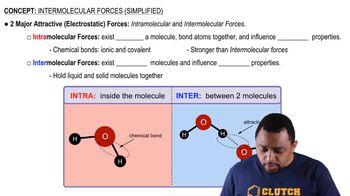
Intermolecular vs Intramolecular Forces