Determine whether each pair of compounds forms a homogeneous solution when combined. For those that form homogeneous solutions, indicate the type of forces that are involved. a. CCl4 and H2O b. KCl and H2O c. Br2 and CCl4
Ch.11 - Liquids, Solids & Intermolecular Forces
11장, 문제 47
Which compound would you expect to have greater surface tension: acetone [(CH3)2CO] or water (H2O)? Explain.
검증된 단계별 안내1
Identify the intermolecular forces present in each compound. Acetone has dipole-dipole interactions and London dispersion forces, while water has hydrogen bonding, dipole-dipole interactions, and London dispersion forces.
Understand that surface tension is influenced by the strength of intermolecular forces. Stronger intermolecular forces result in higher surface tension.
Recognize that hydrogen bonding is a particularly strong type of intermolecular force, which is present in water but not in acetone.
Compare the overall strength of intermolecular forces in acetone and water. Water's hydrogen bonds make its intermolecular forces stronger than those in acetone.
Conclude that water, with its stronger intermolecular forces due to hydrogen bonding, would have a greater surface tension compared to acetone.

비슷한 문제에 대한 검증된 영상 답변:
이 영상 해법은 위 문제에 도움이 된다고 튜터들이 추천한 것입니다.
영상 길이:
59s도움이 되었나요?
주요 개념
질문에 올바르게 답하기 위해 반드시 이해해야 하는 핵심 개념들은 다음과 같습니다.
Surface Tension
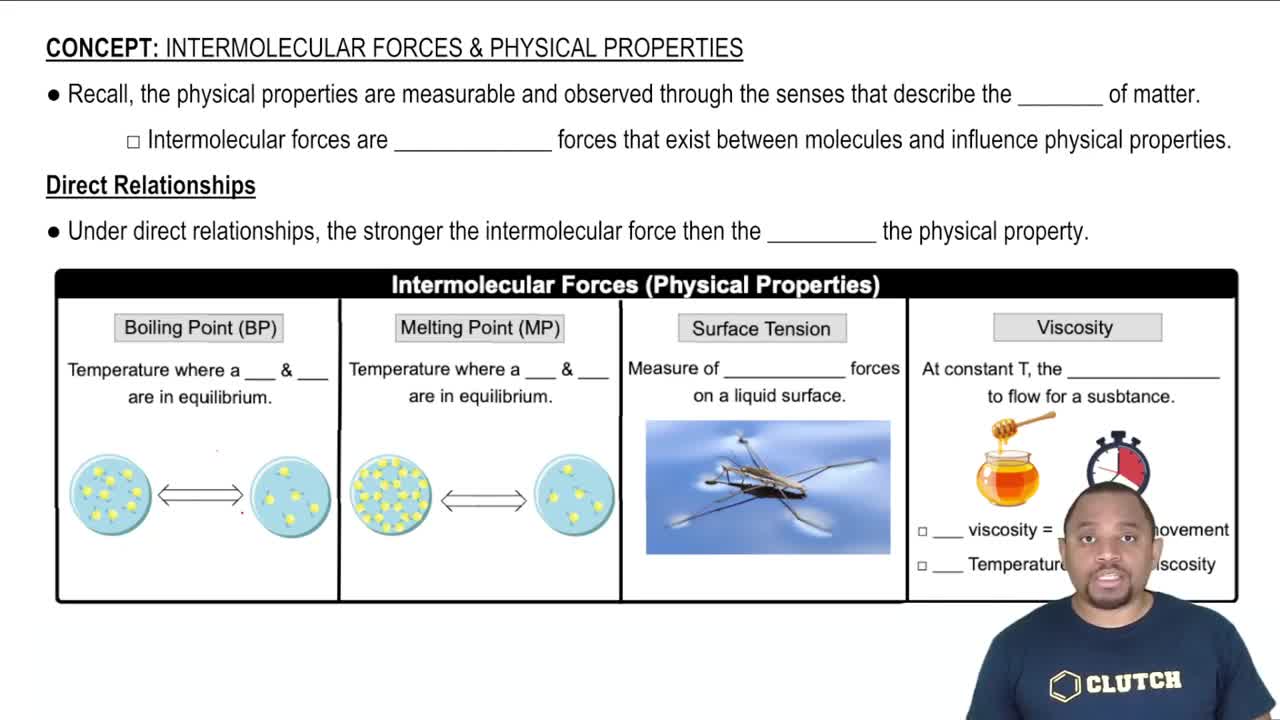
Surface tension is a physical property of liquids that describes the elastic-like force at the surface of a liquid. It arises from the cohesive forces between liquid molecules, which are stronger at the surface due to the lack of neighboring molecules above. This phenomenon causes the surface to behave like a stretched elastic membrane, influencing how liquids interact with solids and other liquids.
추천 영상:
가이드 코스
Intermolecular Forces and Properties
Hydrogen Bonding
Hydrogen bonding is a type of strong intermolecular attraction that occurs when hydrogen is covalently bonded to highly electronegative atoms like oxygen or nitrogen. In water (H2O), each molecule can form up to four hydrogen bonds with neighboring molecules, leading to a highly structured network. This strong bonding significantly contributes to water's high surface tension compared to many other liquids.
추천 영상:
가이드 코스
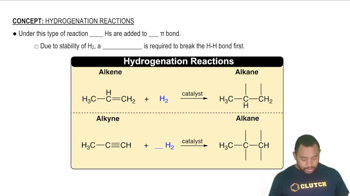
Hydrogenation Reactions
Molecular Structure and Polarity
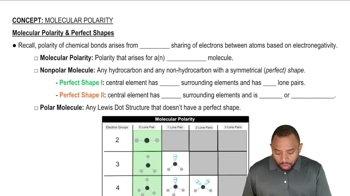
The molecular structure and polarity of a compound greatly influence its physical properties, including surface tension. Water is a polar molecule, meaning it has a partial positive charge on one side and a partial negative charge on the other, allowing for strong intermolecular attractions. In contrast, acetone [(CH3)2CO] is less polar and has weaker intermolecular forces, resulting in lower surface tension compared to water.
추천 영상:
가이드 코스
Molecular Polarity
관련 실천
교과서 질문
1630
views
1
rank
교과서 질문
Explain why the viscosity of multigrade motor oils is less temperature-dependent than that of single-grade motor oils.
750
views
교과서 질문
Determine whether each pair of compounds forms a homogeneous solution when combined. For those that form homogeneous solutions, indicate the type of forces that are involved. d. CH3CH2OH and H2O
1909
views
교과서 질문
Determine whether each pair of compounds forms a homogeneous solution when combined. For those that form homogeneous solutions, indicate the type of forces that are involved. a. CH3CH2CH2CH2CH3 and CH3CH2CH2CH2CH2CH3 b. CBr4 and H2O c. LiNO3 and H2O d. CH3OH and CH3CH2CH2CH2CH3
교과서 질문
The structures of two isomers of heptane are shown. Which of these two compounds would you expect to have the greater viscosity?
1062
views