Ch.12 - Solids and Modern Material
Tro - Chemistry: A Molecular Approach 4th Edition
Tro4th EditionChemistry: A Molecular ApproachISBN: 9780134112831당신이 사용하는 게 아니라요?교과서 변경
12장, 문제 54

Classify each of the following as a component of a silicate ceramic, an oxide ceramic, or a nonoxide ceramic. a. TiB2 b. ZrO2 c. NaAlSi3O8

검증된 단계별 안내
1
Identify the chemical formula of each compound and determine the elements present.
For TiB_2, recognize that it contains titanium (Ti) and boron (B), which are not oxygen, indicating it is a nonoxide ceramic.
For ZrO_2, note that it contains zirconium (Zr) and oxygen (O), classifying it as an oxide ceramic.
For NaAlSi_3O_8, observe that it contains sodium (Na), aluminum (Al), silicon (Si), and oxygen (O), which is characteristic of a silicate ceramic.
Classify each compound based on the presence of oxygen and the type of elements involved: TiB_2 as nonoxide, ZrO_2 as oxide, and NaAlSi_3O_8 as silicate.

비슷한 문제에 대한 검증된 영상 답변:

이 영상 해법은 위 문제에 도움이 된다고 튜터들이 추천한 것입니다.
영상 길이:
1m
도움이 되었나요?

주요 개념

질문에 올바르게 답하기 위해 반드시 이해해야 하는 핵심 개념들은 다음과 같습니다.

Silicate Ceramics

Silicate ceramics are materials primarily composed of silicon and oxygen, often combined with various metal oxides. They are characterized by their high melting points, chemical stability, and mechanical strength. Common examples include feldspar and kaolinite, which are used in pottery and glass production. Understanding the composition of silicate ceramics is essential for classifying materials based on their chemical structure.
추천 영상:
가이드 코스
01:26
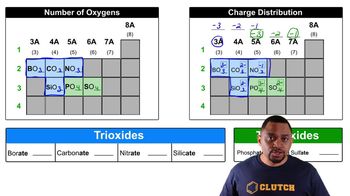
Polyatomic Oxyanion Names

Oxide Ceramics

Oxide ceramics are inorganic compounds that consist mainly of metal oxides, such as alumina (Al2O3) and zirconia (ZrO2). These materials are known for their excellent thermal stability, electrical insulation properties, and resistance to corrosion. Oxide ceramics are widely used in applications ranging from electrical insulators to dental materials. Recognizing the characteristics of oxide ceramics is crucial for proper classification in the context of the question.
추천 영상:
가이드 코스
00:58
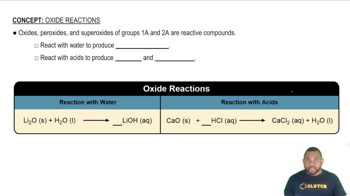
Oxide Reactions

Nonoxide Ceramics

Nonoxide ceramics are a diverse group of materials that do not contain oxygen in their primary structure, often including carbides, nitrides, and borides. Examples include titanium diboride (TiB2) and silicon carbide (SiC), which are known for their hardness and thermal conductivity. These materials are typically used in high-performance applications such as cutting tools and armor. Understanding the classification of nonoxide ceramics is important for accurately categorizing the materials in the question.