Ch.12 - Solids and Modern Material
Tro - Chemistry: A Molecular Approach 4th Edition
Tro4th EditionChemistry: A Molecular ApproachISBN: 9780134112831당신이 사용하는 게 아니라요?교과서 변경
12장, 문제 29c

Determine the number of atoms per unit cell for each metal.
(c) Nickel

검증된 단계별 안내
1
Determine the crystal structure of nickel. Nickel typically crystallizes in a face-centered cubic (FCC) structure.
In an FCC unit cell, atoms are located at each of the eight corners and at the center of each of the six faces.
Calculate the contribution of corner atoms to the unit cell. Each corner atom is shared by eight adjacent unit cells, so each corner atom contributes 1/8 of an atom to the unit cell.
Calculate the contribution of face-centered atoms to the unit cell. Each face-centered atom is shared by two adjacent unit cells, so each face-centered atom contributes 1/2 of an atom to the unit cell.
Add the contributions from corner and face-centered atoms to find the total number of atoms per unit cell in an FCC structure.

비슷한 문제에 대한 검증된 영상 답변:

이 영상 해법은 위 문제에 도움이 된다고 튜터들이 추천한 것입니다.
영상 길이:
3m
도움이 되었나요?

주요 개념

질문에 올바르게 답하기 위해 반드시 이해해야 하는 핵심 개념들은 다음과 같습니다.

Unit Cell

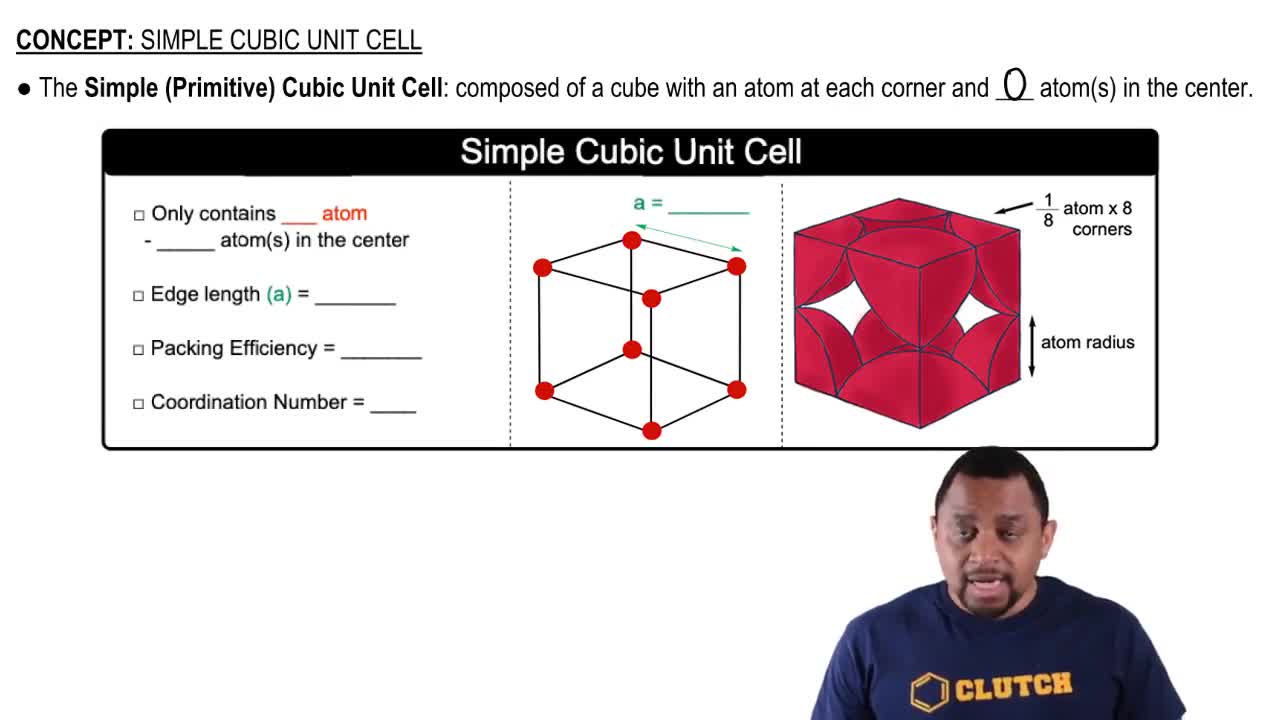
A unit cell is the smallest repeating unit in a crystal lattice that reflects the symmetry and structure of the entire crystal. It defines the arrangement of atoms in a solid and is characterized by its dimensions and angles. Understanding the unit cell is crucial for determining the number of atoms it contains, which is essential for calculating properties like density.
추천 영상:
가이드 코스
01:27
Simple Cubic Unit Cell

Atomic Packing Factor (APF)

The Atomic Packing Factor (APF) is a measure of how efficiently atoms are packed in a unit cell. It is calculated as the volume occupied by the atoms in the unit cell divided by the total volume of the unit cell. Different metals have different APFs based on their crystal structures, which influences their physical properties and the number of atoms per unit cell.
추천 영상:
가이드 코스
01:56
Conversion Factors

Crystal Structure

Crystal structure refers to the ordered arrangement of atoms in a crystalline material. Common types include face-centered cubic (FCC), body-centered cubic (BCC), and hexagonal close-packed (HCP). Each structure has a specific number of atoms per unit cell, which is critical for understanding the material's properties, such as strength and conductivity, particularly for metals like nickel.
추천 영상:
가이드 코스
01:42
Resonance Structures