Ch.12 - Solids and Modern Material
Tro - Chemistry: A Molecular Approach 4th Edition
Tro4th EditionChemistry: A Molecular ApproachISBN: 9780134112831당신이 사용하는 게 아니라요?교과서 변경
12장, 문제 49

Is the structure of each of the two unit cells shown in Problem 47 identifiable as the rock salt structure, zinc blende structure, fluorite structure, antifluorite structure, or is it none of these?

검증된 단계별 안내
1
insert step 1> Identify the characteristics of each structure: Rock salt (NaCl) has a face-centered cubic (FCC) lattice with each ion type occupying octahedral sites. Zinc blende (ZnS) has a cubic close-packed (CCP) lattice with one ion type occupying tetrahedral sites. Fluorite (CaF2) has a cubic structure where the cations form a simple cubic lattice and the anions occupy all the tetrahedral sites. Antifluorite is the inverse of fluorite, where anions form a simple cubic lattice and cations occupy all the tetrahedral sites.
insert step 2> Examine the coordination number and the arrangement of ions in the given unit cells.
insert step 3> Compare the observed coordination numbers and lattice types with those of the known structures.
insert step 4> Determine if the unit cell matches any of the known structures based on the coordination and lattice type.
insert step 5> Conclude whether each unit cell corresponds to rock salt, zinc blende, fluorite, antifluorite, or none of these based on the analysis.

주요 개념

질문에 올바르게 답하기 위해 반드시 이해해야 하는 핵심 개념들은 다음과 같습니다.

Unit Cell Structures

Unit cells are the smallest repeating units in a crystal lattice that define the structure of the entire crystal. They are characterized by their dimensions and the arrangement of atoms within them. Understanding the geometry and coordination of atoms in unit cells is essential for identifying specific crystal structures.
추천 영상:
가이드 코스
01:27
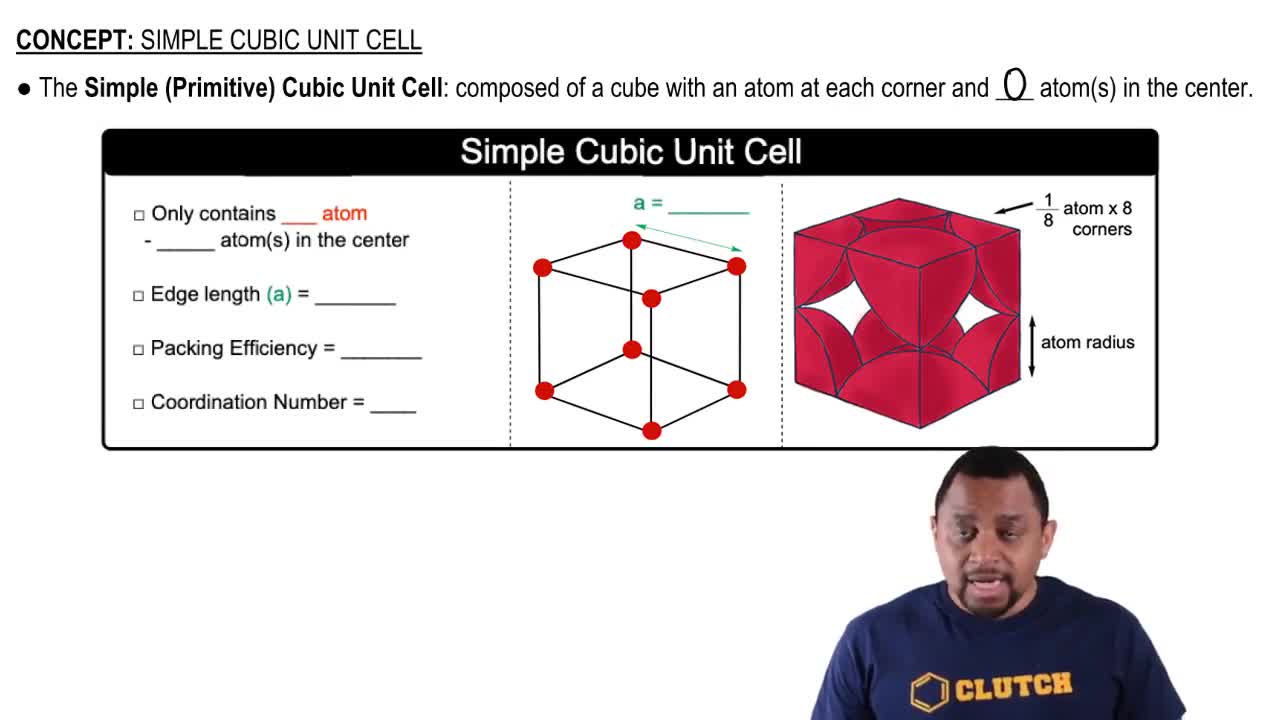
Simple Cubic Unit Cell

Rock Salt Structure

The rock salt structure, also known as the sodium chloride structure, features a face-centered cubic lattice where each sodium ion is surrounded by six chloride ions and vice versa. This arrangement leads to a coordination number of 6 for both types of ions, which is a key characteristic for identifying this structure in crystalline materials.
추천 영상:

Zinc Blende Structure

The zinc blende structure, or sphalerite structure, is characterized by a face-centered cubic lattice where zinc ions are tetrahedrally coordinated by sulfide ions. This results in a coordination number of 4 for both ions. Recognizing this arrangement is crucial for distinguishing it from other structures like rock salt or fluorite.
추천 영상:
가이드 코스
01:42
Resonance Structures