Ch.12 - Solids and Modern Material
Tro - Chemistry: A Molecular Approach 4th Edition
Tro4th EditionChemistry: A Molecular ApproachISBN: 9780134112831당신이 사용하는 게 아니라요?교과서 변경
12장, 문제 34

Molybdenum crystallizes with the body-centered unit cell. The radius of a molybdenum atom is 136 pm. Calculate the edge length of the unit cell and the density of molybdenum

검증된 단계별 안내
1
Step 1: Understand that in a body-centered cubic (bcc) unit cell, atoms at the corners and the center of the cell touch each other along the body diagonal. The length of the body diagonal is equal to 4 times the radius of the atom (4r).
Step 2: The edge length (a) of the unit cell can be found using the Pythagorean theorem in three dimensions, which states that the square of the body diagonal is equal to the sum of the squares of the edge lengths. Since all edges are of equal length in a cubic cell, this simplifies to √3a = 4r. Solve this equation for a to find the edge length of the unit cell.
Step 3: To find the density of molybdenum, first calculate the volume of the unit cell using the formula for the volume of a cube, V = a^3.
Step 4: In a bcc unit cell, there are two atoms per unit cell. So, calculate the mass of two molybdenum atoms. Remember that the molar mass of molybdenum is 95.94 g/mol and Avogadro's number is 6.022 x 10^23 atoms/mol.
Step 5: Finally, calculate the density of molybdenum using the formula density = mass/volume. The mass is the mass of two molybdenum atoms and the volume is the volume of the unit cell calculated in step 3.

비슷한 문제에 대한 검증된 영상 답변:

이 영상 해법은 위 문제에 도움이 된다고 튜터들이 추천한 것입니다.
영상 길이:
7m
도움이 되었나요?

주요 개념

질문에 올바르게 답하기 위해 반드시 이해해야 하는 핵심 개념들은 다음과 같습니다.

Body-Centered Cubic (BCC) Structure

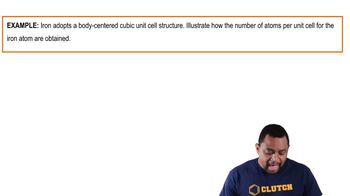
The body-centered cubic (BCC) structure is a type of crystal lattice where atoms are located at each corner of a cube and a single atom is positioned at the center of the cube. In this arrangement, each unit cell contains two atoms, as the corner atoms contribute only a fraction of their volume to the unit cell. Understanding this structure is essential for calculating properties like edge length and density.
추천 영상:
가이드 코스
00:40
Body Centered Cubic Example

Unit Cell Edge Length Calculation

The edge length of a unit cell in a BCC structure can be calculated using the relationship between the atomic radius and the geometry of the unit cell. For BCC, the edge length 'a' is related to the atomic radius 'r' by the formula a = 4r/√3. This relationship is crucial for determining the dimensions of the unit cell based on the given atomic radius.
추천 영상:
가이드 코스
01:27
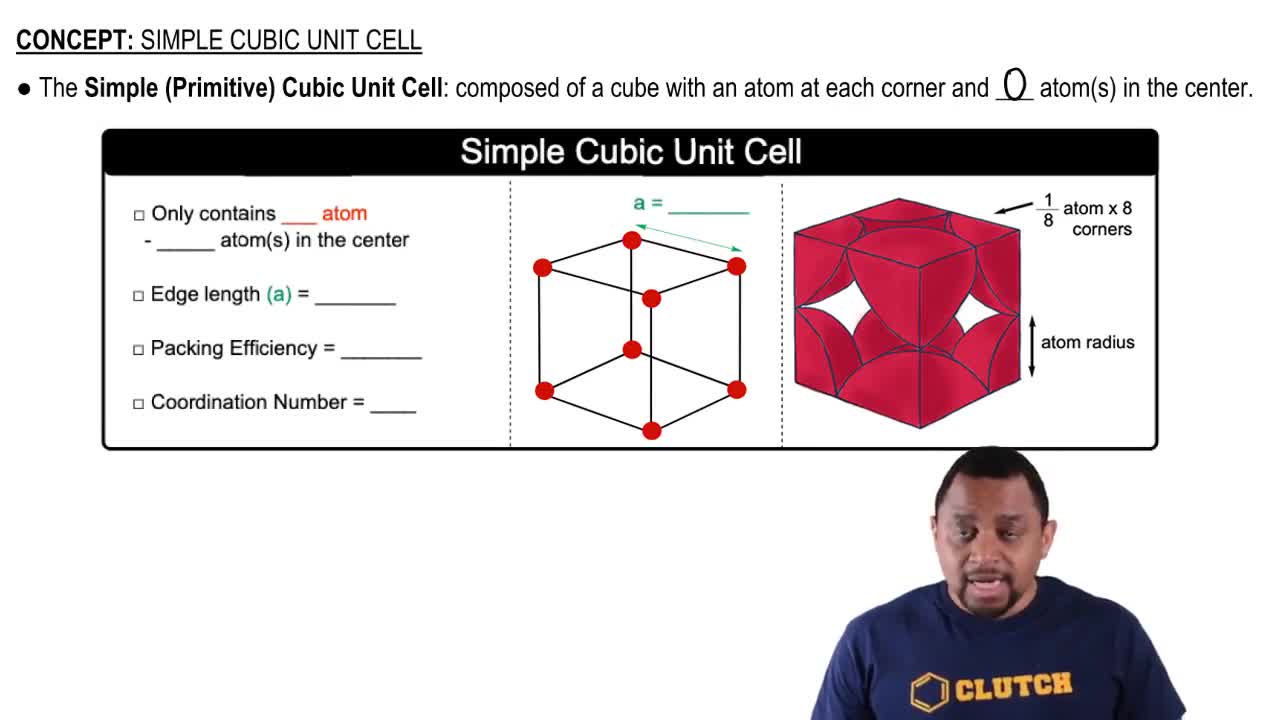
Simple Cubic Unit Cell

Density Calculation

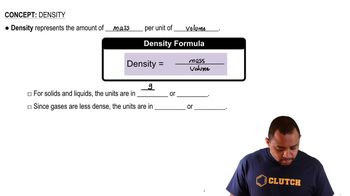
Density is defined as mass per unit volume and can be calculated for a crystalline solid using the formula density = (mass of atoms in unit cell) / (volume of unit cell). For a BCC structure, the mass can be determined from the number of atoms in the unit cell and the molar mass of the element, while the volume is derived from the cube of the edge length. This concept is vital for understanding the material properties of molybdenum.
추천 영상:
가이드 코스
01:56
Density Concepts