Saran, the polymer used to make saran wrap, is an addition polymer formed from two monomers—vinylidene chloride and vinyl chloride. Draw the structure of the polymer. (Hint: The monomers alternate.)
Ch.12 - Solids and Modern Material
12장, 문제 68
What is the wavelength of light (in nm) emitted when an electron moves from the conduction band to the valence band in a sample of diamond, which has a band gap of 5.5 eV?
검증된 단계별 안내1
Convert the band gap energy from electron volts (eV) to joules (J) using the conversion factor: 1 eV = 1.602 x 10^{-19} J.
Use the energy-wavelength relationship given by the equation: E = \(\frac{hc}{\lambda}\), where E is the energy in joules, h is Planck's constant (6.626 x 10^{-34} J·s), c is the speed of light (3.00 x 10^8 m/s), and \(\lambda\) is the wavelength in meters.
Rearrange the equation to solve for wavelength: \(\lambda\) = \(\frac{hc}{E}\).
Substitute the values for h, c, and the converted energy E into the equation to calculate the wavelength in meters.
Convert the wavelength from meters to nanometers by multiplying by 10^9, since 1 meter = 10^9 nanometers.
주요 개념
질문에 올바르게 답하기 위해 반드시 이해해야 하는 핵심 개념들은 다음과 같습니다.
Band Gap Energy
The band gap energy is the energy difference between the conduction band and the valence band in a solid material. It determines the electrical conductivity and optical properties of the material. In semiconductors and insulators, a larger band gap typically means that the material is less conductive and can absorb higher energy photons, which is crucial for understanding electron transitions.
추천 영상:
가이드 코스
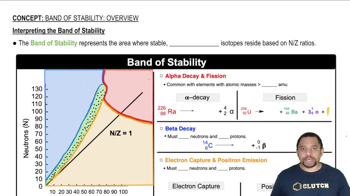
Intepreting the Band of Stability
Photon Energy and Wavelength Relationship
The energy of a photon is inversely related to its wavelength, described by the equation E = hc/λ, where E is energy, h is Planck's constant, c is the speed of light, and λ is the wavelength. This relationship allows us to calculate the wavelength of light emitted when an electron transitions between energy bands, as the energy lost during the transition is emitted as a photon.
추천 영상:
가이드 코스
Frequency-Wavelength Relationship
Electron Transition in Semiconductors
In semiconductors, when an electron moves from the conduction band to the valence band, it releases energy in the form of light (photons). This process is fundamental in understanding how materials like diamond emit light when excited, and the energy of the emitted light corresponds to the band gap energy of the material, which in this case is 5.5 eV for diamond.
추천 영상:
가이드 코스
Electron Configurations Of Transition Metals Example
관련 실천
교과서 질문
1335
views
1
rank
교과서 질문
Polyacrylonitrile (PAN) is an addition polymer with the struc- ture shown here. Draw the structure of the monomer.
1109
views
교과서 질문
Indicate if each solid forms an n-type or a p-type semiconductor. a. germanium doped with gallium b. silicon doped with arsenic
교과서 질문
Does a photon of red light with a frequency of 4.29⨉1014 Hz have sufficient energy to promote an electron from the valence band to the conduction band in a sample of silicon (the band gap in silicon is 1.11 eV)?
467
views
교과서 질문
Teflon is an addition polymer formed from the monomer shown here. Draw the structure of the polymer.
1018
views
교과서 질문
Indicate if each solid forms an n-type or a p-type semiconductor.
a. silicon doped with gallium
b. germanium doped with antimony
456
views