Ch.13 - Solutions
Tro - Chemistry: A Molecular Approach 4th Edition
Tro4th EditionChemistry: A Molecular ApproachISBN: 9780134112831당신이 사용하는 게 아니라요?교과서 변경
13장, 문제 98

An aqueous CaCl2 solution has a vapor pressure of 81.6 mmHg at 50 °C. The vapor pressure of pure water at this temperature is 92.6 mmHg. What is the concentration of CaCl2 in mass percent? (Assume complete dissociation of the solute.)

검증된 단계별 안내
1
Calculate the mole fraction of water (\( X_{H_2O} \)) using Raoult's Law. Raoult's Law states that the vapor pressure of the solution (\( P_{solution} \)) is equal to the product of the mole fraction of the solvent (water) and the vapor pressure of the pure solvent (water). Use the formula: \( X_{H_2O} = \frac{P_{solution}}{P_{pure, H_2O}} \).
Determine the mole fraction of CaCl2 (\( X_{CaCl2} \)) by using the relationship: \( X_{CaCl2} = 1 - X_{H_2O} \).
Calculate the moles of water and CaCl2. Assume a total of 1 kg of the solution and use the density of water (approximately 1 g/mL) to find the mass of water. Convert this mass to moles using the molar mass of water (18.015 g/mol).
Using the mole fraction of CaCl2 and the total moles of the solution, calculate the moles of CaCl2. Remember that CaCl2 dissociates completely into Ca^2+ and 2 Cl^- ions, so account for this in the total number of moles of particles from CaCl2.
Convert the moles of CaCl2 back to mass using its molar mass (110.98 g/mol) and then calculate the mass percent of CaCl2 in the solution using the formula: \( \text{Mass percent} = \left( \frac{\text{mass of CaCl2}}{\text{total mass of solution}} \right) \times 100 \).

비슷한 문제에 대한 검증된 영상 답변:

이 영상 해법은 위 문제에 도움이 된다고 튜터들이 추천한 것입니다.
영상 길이:
7m

주요 개념

질문에 올바르게 답하기 위해 반드시 이해해야 하는 핵심 개념들은 다음과 같습니다.

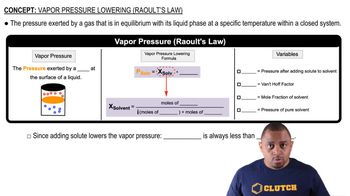
Vapor Pressure and Raoult's Law

Vapor pressure is the pressure exerted by a vapor in equilibrium with its liquid or solid phase. Raoult's Law states that the vapor pressure of a solvent in a solution is directly proportional to the mole fraction of the solvent. This principle is crucial for understanding how the addition of a solute, like CaCl2, lowers the vapor pressure of the solvent (water) in the solution.
추천 영상:
가이드 코스
02:40
Raoult's Law and Vapor Pressure

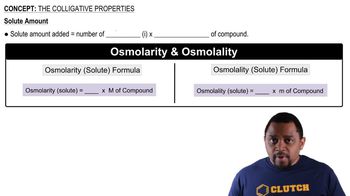
Colligative Properties

Colligative properties are properties of solutions that depend on the number of solute particles in a given amount of solvent, rather than the identity of the solute. These properties include vapor pressure lowering, boiling point elevation, freezing point depression, and osmotic pressure. In this case, the decrease in vapor pressure due to the presence of CaCl2 illustrates this concept, as it dissociates into multiple ions.
추천 영상:
가이드 코스
01:26
Colligative Properties

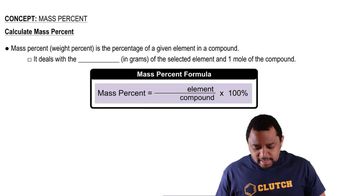
Mass Percent Concentration

Mass percent concentration is a way to express the concentration of a solute in a solution, calculated as the mass of the solute divided by the total mass of the solution, multiplied by 100. To find the mass percent of CaCl2 in the solution, one must first determine the mass of the solute based on the change in vapor pressure and then relate it to the total mass of the solution, which includes both the solute and solvent.
추천 영상:
가이드 코스
00:38
Mass Percent Calculation