Ch.13 - Solutions
Tro - Chemistry: A Molecular Approach 4th Edition
Tro4th EditionChemistry: A Molecular ApproachISBN: 9780134112831당신이 사용하는 게 아니라요?교과서 변경
13장, 문제 112

Magnesium citrate, Mg3(C6H5O7)2, belongs to a class of laxatives called hyperosmotics, which cause rapid emptying of the bowel. When a concentrated solution of magnesium citrate is consumed, it passes through the intestines, drawing water and promoting diarrhea, usually within 6 hours. Calculate the osmotic pressure of a magnesium citrate laxative solution containing 28.5 g of magnesium citrate in 235 mL of solution at 37 °C (approximate body temperature). Assume complete dissociation of the ionic compound.

검증된 단계별 안내
1
Calculate the molar mass of magnesium citrate, Mg3(C6H5O7)2. Add the atomic masses of magnesium (Mg), carbon (C), hydrogen (H), and oxygen (O) according to the formula.
Convert the mass of magnesium citrate given (28.5 g) to moles by dividing by the molar mass calculated in the previous step.
Determine the total volume of the solution in liters by converting the volume from milliliters to liters (235 mL to L).
Calculate the molarity of the solution by dividing the number of moles of magnesium citrate by the volume of the solution in liters.
Use the formula for osmotic pressure: \( \Pi = iMRT \), where \( \Pi \) is the osmotic pressure, \( i \) is the van't Hoff factor (number of particles the compound dissociates into), \( M \) is the molarity of the solution, \( R \) is the ideal gas constant (0.0821 L atm / K mol), and \( T \) is the temperature in Kelvin. Convert 37 °C to Kelvin and calculate the osmotic pressure assuming complete dissociation of magnesium citrate into ions.

비슷한 문제에 대한 검증된 영상 답변:

이 영상 해법은 위 문제에 도움이 된다고 튜터들이 추천한 것입니다.
영상 길이:
2m
도움이 되었나요?

주요 개념

질문에 올바르게 답하기 위해 반드시 이해해야 하는 핵심 개념들은 다음과 같습니다.

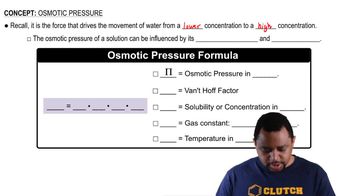
Osmotic Pressure

Osmotic pressure is the pressure required to prevent the flow of solvent into a solution through a semipermeable membrane. It is directly proportional to the concentration of solute particles in the solution, as described by the formula π = iCRT, where π is osmotic pressure, i is the van 't Hoff factor (number of particles the solute dissociates into), C is the molar concentration, R is the ideal gas constant, and T is the temperature in Kelvin.
추천 영상:
가이드 코스
01:13
Osmotic Pressure Formula

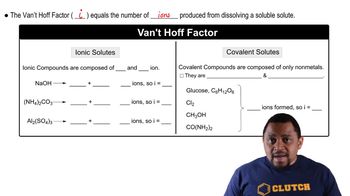
Van 't Hoff Factor

The van 't Hoff factor (i) indicates the number of particles into which a solute dissociates in solution. For magnesium citrate, which dissociates into three magnesium ions (Mg²⁺) and two citrate ions (C6H5O7³⁻), the total number of particles is five. This factor is crucial for calculating osmotic pressure, as it affects the effective concentration of solute particles in the solution.
추천 영상:
가이드 코스
02:50
Van't Hoff Factor

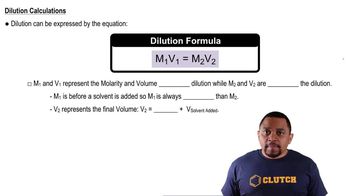
Molarity and Dilution

Molarity (M) is a measure of concentration defined as the number of moles of solute per liter of solution. To calculate osmotic pressure, one must first determine the molarity of magnesium citrate in the solution. This involves converting the mass of magnesium citrate into moles using its molar mass and then dividing by the volume of the solution in liters. Understanding molarity is essential for accurately applying the osmotic pressure formula.
추천 영상:
가이드 코스
00:58
Dilution Equation