
Pick an appropriate solvent from Table 13.3 to dissolve each substance. State the kind of intermolecular forces that would occur between the solute and solvent in each case. a. motor oil (nonpolar) b. ethanol (polar, contains an OH group) c. lard (nonpolar) d. potassium chloride (ionic)
Ch.13 - Solutions
13장, 문제 11
What is the boiling point of an aqueous solution with a vapor pressure of 20.5 torr at 25 °C? (Assume a nonvolatile solute.)
검증된 단계별 안내1
Identify that the problem involves finding the boiling point of a solution, which requires understanding the colligative properties of solutions.
Recognize that the vapor pressure of the solution is given as 20.5 torr at 25 °C, and the normal boiling point of water is 100 °C with a vapor pressure of 760 torr.
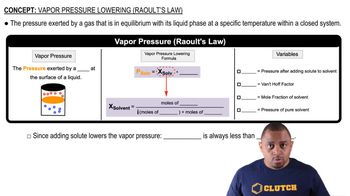
Use Raoult's Law to relate the vapor pressure of the solution to the mole fraction of the solvent: P_solution = X_solvent * P_pure solvent.
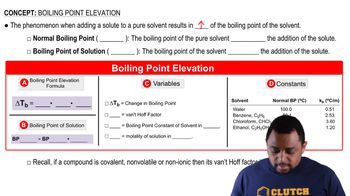
Since the solute is nonvolatile, the vapor pressure lowering can be used to find the boiling point elevation: ΔT_b = i * K_b * m, where i is the van't Hoff factor, K_b is the ebullioscopic constant, and m is the molality.
Calculate the boiling point of the solution by adding the boiling point elevation (ΔT_b) to the normal boiling point of the pure solvent (100 °C).
주요 개념
질문에 올바르게 답하기 위해 반드시 이해해야 하는 핵심 개념들은 다음과 같습니다.
Vapor Pressure
Vapor pressure is the pressure exerted by a vapor in equilibrium with its liquid or solid phase at a given temperature. It reflects the tendency of particles to escape from the liquid phase into the vapor phase. In the context of solutions, the presence of a solute lowers the vapor pressure compared to that of the pure solvent, which is crucial for determining boiling point elevation.
추천 영상:
가이드 코스
Raoult's Law and Vapor Pressure
Boiling Point Elevation
Boiling point elevation is a colligative property that describes how the boiling point of a solvent increases when a nonvolatile solute is added. This phenomenon occurs because the solute particles disrupt the formation of vapor above the liquid, requiring a higher temperature to reach the vapor pressure equal to atmospheric pressure. The relationship is quantified by the formula ΔT_b = i * K_b * m, where ΔT_b is the boiling point elevation, i is the van 't Hoff factor, K_b is the ebullioscopic constant, and m is the molality of the solution.
추천 영상:
가이드 코스
Boiling Point Elevation
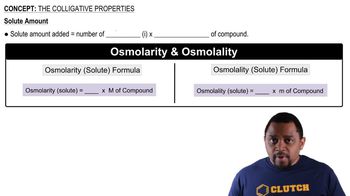
Colligative Properties
Colligative properties are properties of solutions that depend on the number of solute particles in a given amount of solvent, rather than the identity of the solute. These properties include boiling point elevation, freezing point depression, vapor pressure lowering, and osmotic pressure. Understanding colligative properties is essential for predicting how the addition of solute affects the physical properties of a solvent, such as its boiling point.
추천 영상:
가이드 코스
Colligative Properties
관련 실천
교과서 질문
교과서 질문
Pick an appropriate solvent from Table 13.3 to dissolve each substance. State the kind of intermolecular forces that would occur between the solute and solvent in each case. a. isopropyl alcohol (polar, contains an OH group) c. vegetable oil (nonpolar) d. sodium nitrate (ionic)
교과서 질문
Pick an appropriate solvent from Table 13.3 to dissolve each substance. State the kind of intermolecular forces that would occur between the solute and solvent in each case. b. sodium chloride (ionic)
867
views
