Ch.14 - Chemical Kinetics
Tro - Chemistry: A Molecular Approach 4th Edition
Tro4th EditionChemistry: A Molecular ApproachISBN: 9780134112831당신이 사용하는 게 아니라요?교과서 변경
14장, 문제 34

Consider the reaction: 2 H2O2(aq) → 2 H2O(l) + O2(g). The graph shows the concentration of H2O2 as a function of time. Use the graph to calculate each quantity: a. the average rate of the reaction between 10 and 20 seconds, b. the instantaneous rate of the reaction at 30 seconds.

검증된 단계별 안내
1
insert step 1: Identify the relevant data from the graph for the time intervals specified. For part (a), note the concentration of H2O2 at 10 seconds and at 20 seconds. For part (b), note the concentration of H2O2 at 30 seconds.
insert step 2: For part (a), calculate the change in concentration of H2O2 over the time interval from 10 to 20 seconds. This is done by subtracting the concentration at 20 seconds from the concentration at 10 seconds.
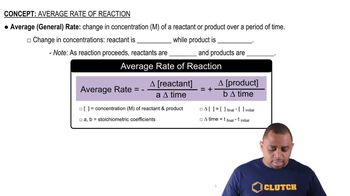
insert step 3: For part (a), calculate the average rate of the reaction by dividing the change in concentration by the change in time (20 seconds - 10 seconds). The average rate is given by the formula: \( \text{Average rate} = -\frac{\Delta [\text{H}_2\text{O}_2]}{\Delta t} \).
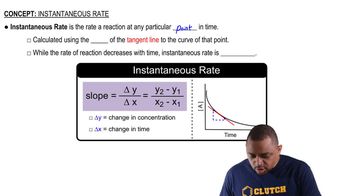
insert step 4: For part (b), to find the instantaneous rate at 30 seconds, determine the slope of the tangent to the curve at 30 seconds. This can be done by drawing a tangent line at 30 seconds and calculating its slope, which is \( -\frac{d[\text{H}_2\text{O}_2]}{dt} \).
insert step 5: Interpret the results: The average rate gives an overall rate of reaction over a time interval, while the instantaneous rate provides the rate at a specific moment in time.

주요 개념

질문에 올바르게 답하기 위해 반드시 이해해야 하는 핵심 개념들은 다음과 같습니다.

Reaction Rate

The reaction rate is a measure of how quickly reactants are converted into products in a chemical reaction. It can be expressed as the change in concentration of a reactant or product over a specific time interval. Understanding both average and instantaneous rates is crucial for analyzing reaction kinetics, as they provide insights into the speed and mechanism of the reaction.
추천 영상:
가이드 코스
02:03
Average Rate of Reaction

Average Rate of Reaction

The average rate of reaction is calculated by taking the change in concentration of a reactant or product over a defined time period. For the reaction given, it involves determining the difference in concentration of H2O2 between 10 and 20 seconds and dividing it by the time interval. This provides a general overview of how fast the reaction occurs over that specific timeframe.
추천 영상:
가이드 코스
02:03
Average Rate of Reaction

Instantaneous Rate of Reaction

The instantaneous rate of reaction refers to the rate at a specific moment in time, often determined by the slope of the concentration vs. time graph at that point. For the reaction at 30 seconds, this involves finding the tangent to the curve at that time, which reflects the rate of change of concentration of H2O2 at that exact moment, providing a more precise understanding of the reaction dynamics.
추천 영상:
가이드 코스
01:30
Instantaneous Rate