
Consider the gas-phase reaction: H2(g) + I2(g) → 2 HI(g) The reaction was experimentally determined to be first order in H2 and first order in I2. Consider the proposed mechanisms. Proposed mechanism I: H2(g) + I2(g) → 2 HI(g) Single step Proposed mechanism II: I2(g) Δk1k-12 I(g) Fast H2( g) + 2 I( g) → k22 HI( g) Slow b. What kind of experimental evidence might lead you to favor mechanism II over mechanism I?
Ch.14 - Chemical Kinetics
14장, 문제 106a
Consider the reaction: 2 NH3(aq) + OCl-(aq) → N2H4(aq) + H2O(l) + Cl- (aq) This three-step mechanism is proposed: NH3(aq) + OCl- (aq) Δk1k2 NH2Cl(aq) + OH- (aq) Fast NH2Cl(aq) + NH3(aq) →k3 N2H5+ (aq) + Cl- (aq) Slow N2H5+ (aq) + OH-(aq) →k4 N2H4(aq) + H2O(l) Fast a. Show that the mechanism sums to the overall reaction.
검증된 단계별 안내1
Identify the reactants and products in each step of the mechanism.
Write down the reactants and products for each step: Step 1: NH_3(aq) + OCl^-(aq) \(\rightleftharpoons\) NH_2Cl(aq) + OH^-(aq), Step 2: NH_2Cl(aq) + NH_3(aq) \(\rightarrow\) N_2H_5^+(aq) + Cl^-(aq), Step 3: N_2H_5^+(aq) + OH^-(aq) \(\rightarrow\) N_2H_4(aq) + H_2O(l).
Add up all the reactants from each step and all the products from each step.
Cancel out any intermediates or species that appear on both sides of the equation.
Verify that the remaining reactants and products match the overall reaction: 2 NH_3(aq) + OCl^-(aq) \(\rightarrow\) N_2H_4(aq) + H_2O(l) + Cl^-(aq).

비슷한 문제에 대한 검증된 영상 답변:
이 영상 해법은 위 문제에 도움이 된다고 튜터들이 추천한 것입니다.
영상 길이:
1m주요 개념
질문에 올바르게 답하기 위해 반드시 이해해야 하는 핵심 개념들은 다음과 같습니다.
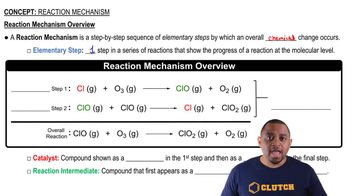
Reaction Mechanism
A reaction mechanism is a step-by-step description of the pathway taken during a chemical reaction. It outlines the individual elementary steps that lead to the overall reaction, including the formation and consumption of intermediates. Understanding the mechanism helps in predicting the rate and outcome of the reaction, as well as identifying the role of catalysts and inhibitors.
추천 영상:
가이드 코스
Reaction Mechanism Overview
Rate-Determining Step
The rate-determining step is the slowest step in a reaction mechanism that controls the overall reaction rate. It is crucial because the speed of this step dictates how quickly the entire reaction proceeds. In the provided mechanism, identifying the slow step allows for a better understanding of how the reaction progresses and how changes in conditions might affect the rate.
추천 영상:
가이드 코스
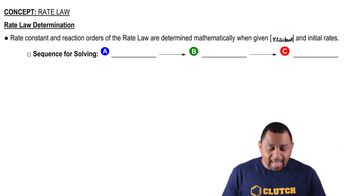
Rate Law Determination
Stoichiometry
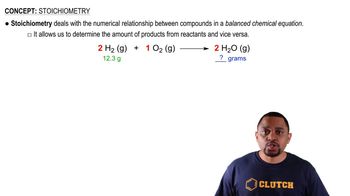
Stoichiometry involves the calculation of reactants and products in chemical reactions based on the balanced equation. It ensures that the law of conservation of mass is upheld, meaning the number of atoms of each element must be the same on both sides of the equation. In this context, verifying that the sum of the elementary steps matches the overall reaction requires careful stoichiometric analysis.
추천 영상:
가이드 코스
Stoichiometry Concept
관련 실천
교과서 질문
1632
views
교과서 질문
A certain substance X decomposes. Fifty percent of X remains after 100 minutes. How much X remains after 200 minutes if the reaction order with respect to X is (c) second order?
1403
views
교과서 질문
Consider the gas-phase reaction: H2(g) + I2(g) → 2 HI(g) The reaction was experimentally determined to be first order in H2 and first order in I2. Consider the proposed mechanisms. Proposed mechanism I: H2(g) + I2(g) → 2 HI(g) Single step Proposed mechanism II: I2(g) Δk1k-12 I(g) Fast H2( g) + 2 I( g) → k22 HI( g) Slow a. Show that both of the proposed mechanisms are valid.
650
views
