Ch.14 - Chemical Kinetics
Tro - Chemistry: A Molecular Approach 4th Edition
Tro4th EditionChemistry: A Molecular ApproachISBN: 9780134112831당신이 사용하는 게 아니라요?교과서 변경
14장, 문제 85

Consider the reaction: A + B + C → D. The rate law for this reaction is: Rate = k [A][C]^2 [B]^1/2. Suppose the rate of the reaction at certain initial concentrations of A, B, and C is 0.0115 M/s. What is the rate of the reaction if the concentrations of A and C are doubled and the concentration of B is tripled?

검증된 단계별 안내
1
Identify the given rate law: Rate = k [A][C]^2 [B]^{1/2}.
Note the initial rate of the reaction: 0.0115 M/s.
Determine the effect of doubling the concentration of A: The rate will be multiplied by 2, since the reaction is first order with respect to A.
Determine the effect of doubling the concentration of C: The rate will be multiplied by 2^2 = 4, since the reaction is second order with respect to C.
Determine the effect of tripling the concentration of B: The rate will be multiplied by (3)^{1/2}, since the reaction is half order with respect to B.

주요 개념

질문에 올바르게 답하기 위해 반드시 이해해야 하는 핵심 개념들은 다음과 같습니다.

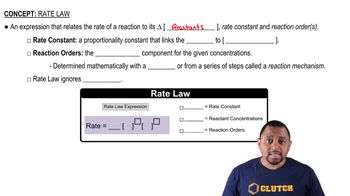
Rate Law

The rate law of a chemical reaction expresses the relationship between the reaction rate and the concentrations of the reactants. It is typically formulated as Rate = k [A]^m [B]^n [C]^p, where k is the rate constant, and m, n, and p are the reaction orders with respect to each reactant. Understanding the rate law is essential for predicting how changes in concentration affect the reaction rate.
추천 영상:
가이드 코스
01:52
Rate Law Fundamentals

Reaction Order

Reaction order refers to the exponent of a reactant's concentration in the rate law, indicating how the rate of reaction is affected by that reactant. For example, in the rate law Rate = k [A][C]^2 [B]^1/2, the reaction is first order with respect to A, second order with respect to C, and half order with respect to B. This concept is crucial for calculating the new rate when concentrations change.
추천 영상:
가이드 코스
00:36
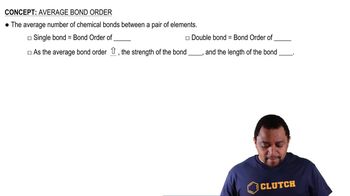
Average Bond Order

Concentration Changes

Changes in the concentrations of reactants directly influence the rate of a reaction according to the rate law. In this scenario, if the concentrations of A and C are doubled and B is tripled, the new rate can be calculated by substituting these new concentrations into the rate law. Understanding how to manipulate these concentrations is key to determining the new reaction rate.
추천 영상:
가이드 코스
01:53
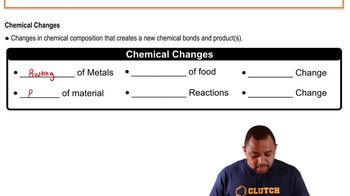
Chemical Changes