
Ch.14 - Chemical Kinetics
Tro - Chemistry: A Molecular Approach 4th Edition
Tro4th EditionChemistry: A Molecular ApproachISBN: 9780134112831당신이 사용하는 게 아니라요?교과서 변경
14장, 문제 102a

Consider the two reactions:
O + N2 → NO + N Ea = 315 kJ/mol
Cl + H2 → HCl + H Ea = 23 kJ/mol
a. Why is the activation barrier for the first reaction so much higher than that for the second?

검증된 단계별 안내
1
Identify the two reactions and their activation energies: Reaction 1: O + N_2 \(\rightarrow\) NO + N with E_a = 315 \(\text{ kJ/mol}\), Reaction 2: Cl + H_2 \(\rightarrow\) HCl + H with E_a = 23 \(\text{ kJ/mol}\).
Understand that activation energy (E_a) is the minimum energy required for a reaction to occur. It represents the energy barrier that must be overcome for reactants to transform into products.
Consider the bond strengths involved in each reaction. In Reaction 1, breaking the triple bond in N_2 requires a significant amount of energy, contributing to a higher activation energy.
In Reaction 2, the bond between H_2 is weaker compared to the N_2 bond, and the formation of HCl is highly exothermic, resulting in a lower activation energy.
Conclude that the higher activation energy in Reaction 1 is due to the strong N_2 bond, which requires more energy to break, compared to the weaker H_2 bond in Reaction 2.

비슷한 문제에 대한 검증된 영상 답변:

이 영상 해법은 위 문제에 도움이 된다고 튜터들이 추천한 것입니다.
영상 길이:
3m

주요 개념

질문에 올바르게 답하기 위해 반드시 이해해야 하는 핵심 개념들은 다음과 같습니다.

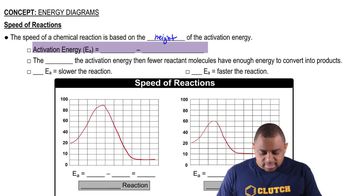
Activation Energy (E<sub>a</sub>)

Activation energy is the minimum energy required for a chemical reaction to occur. It represents the energy barrier that reactants must overcome to transform into products. A higher activation energy indicates that the reaction is less likely to occur at a given temperature, as fewer molecules will have sufficient energy to surpass this barrier.
추천 영상:
가이드 코스
02:02
Speed of Reactions

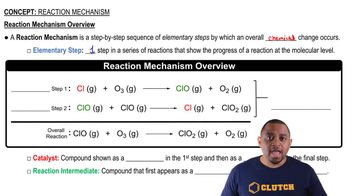
Reaction Mechanism

A reaction mechanism is a step-by-step description of the pathway taken during a chemical reaction. It includes the sequence of elementary steps that lead to the formation of products from reactants. The complexity of the mechanism can influence the activation energy, as more steps may involve higher energy transitions.
추천 영상:
가이드 코스
03:06
Reaction Mechanism Overview

Bond Strength and Stability

The strength of bonds in reactants and products affects the activation energy of a reaction. Stronger bonds require more energy to break, leading to higher activation energies. In the given reactions, the nature of the bonds formed and broken (e.g., O-N vs. Cl-H) contributes to the differences in activation barriers, as stronger bonds typically correlate with higher energy requirements.
추천 영상:
가이드 코스
03:13
Intepreting the Band of Stability