Which of these two reactions would you expect to have the smaller orientation factor? Explain. a. O(g) + N2(g) → NO( g) + N(g) b. NO(g) + Cl2(g) → NOCl( g) + Cl(g)
Ch.14 - Chemical Kinetics
14장, 문제 77a
Consider this three-step mechanism for a reaction:
Cl2 (g) k1⇌k2 2 Cl (g) Fast
Cl (g) + CHCl3 (g) →k3 HCl (g) + CCl3 (g) Slow
Cl (g) + CCl3 (g) →k4 CCl4 (g) Fast
a. What is the overall reaction?
검증된 단계별 안내1
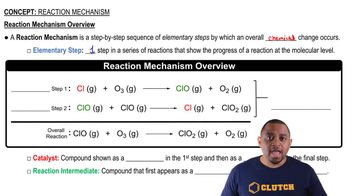
Identify the reactants and products in each step of the mechanism. For the first step, the reactants are Cl2 and the products are 2 Cl. In the second step, the reactants are Cl and CHCl3, and the products are HCl and CCl3. In the third step, the reactants are Cl and CCl3, and the product is CCl4.
Determine the intermediates by identifying species that appear as products in one step and reactants in another. Here, Cl and CCl3 are intermediates as they are produced in one step and consumed in another.
Cancel out the intermediates from the overall reaction. Since Cl and CCl3 are intermediates, they should not appear in the final balanced equation.
Write the overall reaction by combining the remaining reactants and products, ensuring to balance the equation. Start with the initial reactants that are not intermediates and include the final products that are not intermediates.
Check the stoichiometry of the final equation to ensure that the number of atoms of each element is the same on both sides of the equation.

비슷한 문제에 대한 검증된 영상 답변:
이 영상 해법은 위 문제에 도움이 된다고 튜터들이 추천한 것입니다.
영상 길이:
2m도움이 되었나요?
주요 개념
질문에 올바르게 답하기 위해 반드시 이해해야 하는 핵심 개념들은 다음과 같습니다.
Reaction Mechanism
A reaction mechanism is a step-by-step description of how a chemical reaction occurs at the molecular level. It outlines the individual elementary steps that lead to the overall reaction, including the formation and consumption of intermediates. Understanding the mechanism helps in predicting the rate and outcome of the reaction.
추천 영상:
가이드 코스
Reaction Mechanism Overview
Elementary Steps
Elementary steps are the individual reactions that make up a reaction mechanism. Each step represents a single molecular event, such as the collision of reactants or the formation of products. The rate of the overall reaction is often determined by the slowest elementary step, known as the rate-determining step.
추천 영상:
가이드 코스
Reaction Mechanism Overview
Overall Reaction
The overall reaction is the net equation that summarizes the reactants and products of a chemical process, derived from the individual elementary steps. It reflects the stoichiometry of the reaction and provides insight into the conservation of mass. To find the overall reaction, one must combine the elementary steps while canceling out any intermediates.
추천 영상:
가이드 코스
Overall Reaction Equilibrium Constant
관련 실천
교과서 질문
1178
views
교과서 질문
Consider this three-step mechanism for a reaction:
Cl2 (g) k1⇌k2 2 Cl (g) Fast
Cl (g) + CHCl3 (g) →k3 HCl (g) + CCl3 (g) Slow
Cl (g) + CCl3 (g) →k4 CCl4 (g) Fast
c. What is the predicted rate law?
3695
views
교과서 질문
Consider this three-step mechanism for a reaction:
Cl2 (g) k1⇌k2 2 Cl (g) Fast
Cl (g) + CHCl3 (g) →k3 HCl (g) + CCl3 (g) Slow
Cl (g) + CCl3 (g) →k4 CCl4 (g) Fast
b. Identify the intermediates in the mechanism.
교과서 질문
Consider this overall reaction, which is experimentally observed to be second order in AB and zero order in C: AB + C → A + BC Is the following mechanism valid for this reaction? AB + AB →k1 AB2 + A Slow AB2 + C → k2 AB + BC Fast
2451
views
1
comments