Ch.14 - Chemical Kinetics
Tro - Chemistry: A Molecular Approach 4th Edition
Tro4th EditionChemistry: A Molecular ApproachISBN: 9780134112831당신이 사용하는 게 아니라요?교과서 변경
14장, 문제 112b

Ethyl chloride vapor decomposes by the first-order reaction: C2H5Cl → C2H4 + HCl The activation energy is 249 kJ/mol, and the frequency factor is 1.6⨉1014 s-1. What fraction of the ethyl chloride decomposes in 15 minutes at this temperature?

검증된 단계별 안내
1
Identify the given data: activation energy (E_a = 249 \(\text{ kJ/mol}\)), frequency factor (A = 1.6 \(\times\) 10^{14} \(\text{ s}\)^{-1}), and time (t = 15 \(\text{ minutes}\)).
Convert the time from minutes to seconds for consistency in units: t = 15 \(\times\) 60 \(\text{ seconds}\).
Use the Arrhenius equation to find the rate constant (k): k = A \(\cdot\) e^{-E_a/(RT)}, where R is the gas constant (8.314 \(\text{ J/mol K}\)) and T is the temperature in Kelvin.
Assume a temperature to calculate the rate constant (k) using the Arrhenius equation. Note that the temperature is not provided, so this is a hypothetical step.
Use the first-order kinetics formula to find the fraction decomposed: \(\text{Fraction decomposed}\) = 1 - e^{-kt}, where k is the rate constant and t is the time in seconds.

비슷한 문제에 대한 검증된 영상 답변:

이 영상 해법은 위 문제에 도움이 된다고 튜터들이 추천한 것입니다.
영상 길이:
2m

주요 개념

질문에 올바르게 답하기 위해 반드시 이해해야 하는 핵심 개념들은 다음과 같습니다.

First-Order Reactions

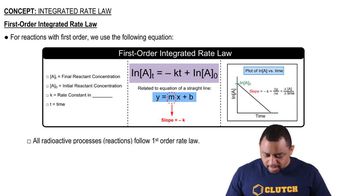
First-order reactions are chemical reactions where the rate is directly proportional to the concentration of one reactant. This means that as the concentration of the reactant decreases, the rate of reaction also decreases. The integrated rate law for a first-order reaction can be expressed as ln([A]₀/[A]) = kt, where [A]₀ is the initial concentration, [A] is the concentration at time t, k is the rate constant, and t is time.
추천 영상:
가이드 코스
02:29
First-Order Reactions

Arrhenius Equation

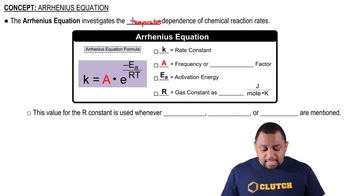
The Arrhenius equation relates the rate constant of a reaction to the temperature and activation energy. It is expressed as k = A * e^(-Ea/RT), where k is the rate constant, A is the frequency factor, Ea is the activation energy, R is the universal gas constant, and T is the temperature in Kelvin. This equation helps in understanding how temperature affects reaction rates and is crucial for calculating k when given Ea and A.
추천 영상:
가이드 코스
01:20
Arrhenius Equation

Fraction Decomposed

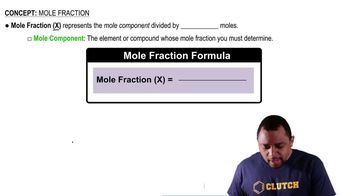
The fraction decomposed in a reaction can be calculated using the integrated rate law for first-order kinetics. By rearranging the equation, one can find the concentration of the reactant at a given time and then determine the fraction that has reacted. This is important for understanding the extent of the reaction over a specified time period, such as the 15 minutes mentioned in the question.
추천 영상:
가이드 코스
00:36
Mole Fraction Formula