
Iodine atoms combine to form I2 in liquid hexane solvent with a rate constant of 1.5⨉1010 L/mols. The reaction is second order in I. Since the reaction occurs so quickly, the only way to study the reaction is to create iodine atoms almost instantaneously, usually by photochemical decomposition of I2. Suppose a flash of light creates an initial [I] concentration of 0.0100 M. How long will it take for 95% of the newly created iodine atoms to recombine to form I2?
Ch.14 - Chemical Kinetics
14장, 문제 92
Is the question asking for the mass of sucrose hydrolyzed when 2.55 L of a 0.150 M sucrose solution is allowed to react for 195 minutes, given that the hydrolysis of sucrose (C12H22O11) into glucose and fructose in acidic water has a rate constant of 1.8 * 10^-4 s^-1 at 25 °C and the reaction is first order in sucrose?
검증된 단계별 안내1
Identify the type of reaction: The problem states that the hydrolysis of sucrose is a first-order reaction. This means the rate of reaction depends linearly on the concentration of sucrose.
Use the first-order rate equation: The integrated rate law for a first-order reaction is \( \ln \left( \frac{[A]_0}{[A]} \right) = kt \), where \([A]_0\) is the initial concentration, \([A]\) is the concentration at time \(t\), \(k\) is the rate constant, and \(t\) is the time.
Convert time to seconds: Since the rate constant \(k\) is given in \(s^{-1}\), convert the time from minutes to seconds by multiplying 195 minutes by 60 seconds per minute.
Calculate the remaining concentration of sucrose: Rearrange the first-order rate equation to solve for \([A]\), the concentration of sucrose at time \(t\).
Determine the mass of sucrose hydrolyzed: Calculate the initial moles of sucrose using the initial concentration and volume, then find the moles of sucrose remaining after the reaction. Subtract to find the moles hydrolyzed and convert to mass using the molar mass of sucrose.
주요 개념
질문에 올바르게 답하기 위해 반드시 이해해야 하는 핵심 개념들은 다음과 같습니다.
Molarity and Volume Calculations
Molarity (M) is a measure of concentration defined as the number of moles of solute per liter of solution. To find the number of moles of sucrose in a solution, you can multiply the molarity by the volume in liters. In this case, with a 0.150 M sucrose solution and a volume of 2.55 L, the total moles of sucrose can be calculated, which is essential for determining the mass hydrolyzed.
추천 영상:
가이드 코스
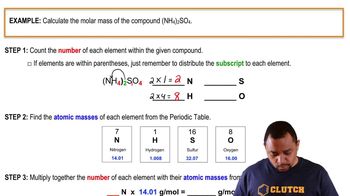
Molar Mass Calculation Example
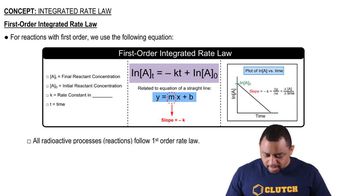
First-Order Reaction Kinetics
In a first-order reaction, the rate of reaction is directly proportional to the concentration of one reactant. The rate constant (k) is a crucial parameter that defines the speed of the reaction. For the hydrolysis of sucrose, the rate constant is given as 1.8 * 10^-4 s^-1, which can be used to calculate the change in concentration over time, allowing us to determine how much sucrose has reacted.
추천 영상:
가이드 코스
First-Order Reactions
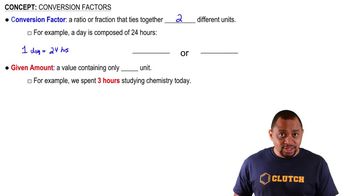
Time Conversion and Reaction Progress
To analyze the reaction over a specific time period, it is important to convert time into the appropriate units that match the rate constant. In this case, 195 minutes must be converted into seconds to align with the rate constant's units. Understanding how to relate time to concentration changes is vital for calculating the amount of sucrose hydrolyzed during the reaction.
추천 영상:
가이드 코스
Conversion Factors
관련 실천
교과서 질문
2152
views
교과서 질문
Dinitrogen pentoxide decomposes in the gas phase to form nitrogen dioxide and oxygen gas. The reaction is first order in dinitrogen pentoxide and has a half-life of 2.81 h at 25 °C. If a 1.5-L reaction vessel initially contains 745 torr of N2O5 at 25 °C, what partial pressure of O2 is present in the vessel after 215 minutes?
4875
views
1
rank
1
comments
교과서 질문
Consider this energy diagram:
a. How many elementary steps are involved in this reaction?
1017
views
1
comments
