Ch.14 - Chemical Kinetics
Tro - Chemistry: A Molecular Approach 4th Edition
Tro4th EditionChemistry: A Molecular ApproachISBN: 9780134112831당신이 사용하는 게 아니라요?교과서 변경
14장, 문제 54d

This reaction was monitored as a function of time: AB → A + B A plot of 1/[AB] versus time yields a straight line with a slope of +0.55/Ms.
d. If the initial concentration of AB is 0.250 M, and the reaction mixture initially contains no products, what are the concentrations of A and B after 75 s?

검증된 단계별 안내
1
Identify the order of the reaction. Since a plot of \( \frac{1}{[\text{AB}]} \) versus time is a straight line, the reaction is second-order with respect to AB.
Use the second-order integrated rate law: \( \frac{1}{[\text{AB}]} = kt + \frac{1}{[\text{AB}]_0} \), where \( k \) is the rate constant, \( t \) is time, and \( [\text{AB}]_0 \) is the initial concentration.
Substitute the given values into the integrated rate law: \( \frac{1}{[\text{AB}]} = 0.55 \times 75 + \frac{1}{0.250} \).
Solve for \( [\text{AB}] \) to find the concentration of AB at 75 seconds.
Since the reaction is \( \text{AB} \rightarrow \text{A} + \text{B} \), the change in concentration of AB is equal to the increase in concentration of A and B. Calculate \( [\text{A}] = [\text{B}] = [\text{AB}]_0 - [\text{AB}] \).

비슷한 문제에 대한 검증된 영상 답변:

이 영상 해법은 위 문제에 도움이 된다고 튜터들이 추천한 것입니다.
영상 길이:
3m
도움이 되었나요?

주요 개념

질문에 올바르게 답하기 위해 반드시 이해해야 하는 핵심 개념들은 다음과 같습니다.

Rate Law and Reaction Order

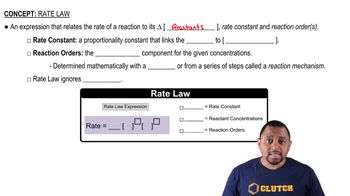
The rate law expresses the relationship between the rate of a chemical reaction and the concentration of its reactants. For the reaction AB → A + B, the straight line plot of 1/[AB] versus time indicates that the reaction is second-order with respect to AB. This means that the rate of reaction is proportional to the square of the concentration of AB, which is crucial for determining how concentrations change over time.
추천 영상:
가이드 코스
01:52
Rate Law Fundamentals

Integrated Rate Law for Second-Order Reactions

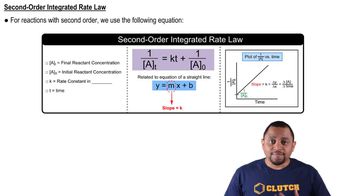
For a second-order reaction, the integrated rate law is given by 1/[AB] = kt + 1/[AB]₀, where k is the rate constant, t is time, and [AB]₀ is the initial concentration. This equation allows us to calculate the concentration of AB at any time, which can then be used to find the concentrations of the products A and B, since they are produced in a 1:1 ratio.
추천 영상:
가이드 코스
01:59
Second-Order Reactions

Stoichiometry of the Reaction

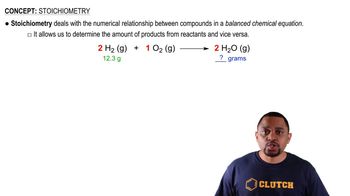
Stoichiometry involves the quantitative relationships between reactants and products in a chemical reaction. In this case, for every mole of AB that reacts, one mole of A and one mole of B are produced. Therefore, knowing the change in concentration of AB allows us to directly calculate the concentrations of A and B after a given time, based on the initial concentration and the amount reacted.
추천 영상:
가이드 코스
01:16
Stoichiometry Concept