Ch.15 - Chemical Equilibrium
Tro - Chemistry: A Molecular Approach 4th Edition
Tro4th EditionChemistry: A Molecular ApproachISBN: 9780134112831당신이 사용하는 게 아니라요?교과서 변경
15장, 문제 26

A chemist trying to synthesize a particular compound attempts two different synthesis reactions. The equilibrium constants for the two reactions are 23.3 and 2.2⨉104 at room temperature. However, upon carrying out both reactions for 15 minutes, the chemist finds that the reaction with the smaller equilibrium constant produces more of the desired product. Explain how this might be possible.

검증된 단계별 안내
1
1. The equilibrium constant (K) of a reaction is a measure of the ratio of the concentrations of the products to the reactants at equilibrium. A larger K value indicates that the reaction favors the products, while a smaller K value indicates that the reaction favors the reactants.
2. However, the equilibrium constant does not provide information about the rate at which the reaction occurs. It is possible for a reaction to have a large equilibrium constant (favoring products) but be very slow, so that it takes a long time to reach equilibrium.
3. The rate of a reaction is determined by the activation energy and the temperature, among other factors. A reaction with a lower activation energy will proceed faster than a reaction with a higher activation energy, all else being equal.
4. In this case, even though the reaction with the smaller equilibrium constant does not favor the products as much, it may have a lower activation energy and therefore proceed faster. This would allow it to produce more product in a given amount of time.
5. Therefore, the reaction with the smaller equilibrium constant could produce more of the desired product in 15 minutes if it has a faster rate than the reaction with the larger equilibrium constant.

비슷한 문제에 대한 검증된 영상 답변:

이 영상 해법은 위 문제에 도움이 된다고 튜터들이 추천한 것입니다.
영상 길이:
59s
도움이 되었나요?

주요 개념

질문에 올바르게 답하기 위해 반드시 이해해야 하는 핵심 개념들은 다음과 같습니다.

Equilibrium Constant (K)

The equilibrium constant (K) is a numerical value that expresses the ratio of the concentrations of products to reactants at equilibrium for a given reaction at a specific temperature. A higher K value indicates a greater tendency for the reaction to favor product formation, while a lower K suggests a preference for reactants. However, K does not provide information about the rate of the reaction or how quickly equilibrium is reached.
추천 영상:
가이드 코스
01:14
Equilibrium Constant K

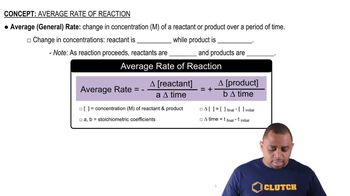
Reaction Rate

The reaction rate refers to the speed at which reactants are converted into products in a chemical reaction. It is influenced by factors such as concentration, temperature, and the presence of catalysts. Even if a reaction has a lower equilibrium constant, it may proceed at a faster rate initially, allowing it to produce more product before reaching equilibrium compared to a slower reaction with a higher K value.
추천 영상:
가이드 코스
02:03
Average Rate of Reaction

Time to Reach Equilibrium

The time it takes for a reaction to reach equilibrium can vary significantly between different reactions. Some reactions may reach equilibrium quickly, while others take longer. In the scenario described, the reaction with the smaller equilibrium constant may have produced more product in the short term (15 minutes) due to its faster reaction kinetics, despite having a lower overall yield at equilibrium.
추천 영상:
가이드 코스
02:35
Thermal Equilibrium
관련 실천
교과서 질문

This reaction has an equilibrium constant of Kp = 2.26⨉104 at 298 K. CO(g) + 2 H2(g) ⇌ CH3OH(g) Calculate Kp for each reaction and predict whether reactants or products will be favored at equilibrium. a. CH3OH(g) ⇌ CO(g) + 2 H2(g)

790
views

교과서 질문

When this reaction comes to equilibrium, will the concentrations of the reactants or products be greater? Does the answer to this question depend on the initial concentrations of the reactants and products? A(g)+B(g) ⇌ 2 C(g) Kc = 1.4⨉10-5

1500
views
교과서 질문

This reaction has an equilibrium constant of Kp = 2.26⨉104 at 298 K. CO(g) + 2 H2(g) ⇌ CH3OH(g) Calculate Kp for each reaction and predict whether reactants or products will be favored at equilibrium.

c. 2 CH3OH(g) ⇌ 2 CO(g) + 4 H2(g)

726
views
교과서 질문

This reaction has an equilibrium constant of Kp = 2.26⨉104 at 298 K. CO(g) + 2 H2(g) ⇌ CH3OH(g) Calculate Kp for each reaction and predict whether reactants or products will be favored at equilibrium.

b. 1/2 CO(g) + H2 (g) ⇌ 1/2 CH3OH(g)

3230
views
교과서 질문

H2 and I2 are combined in a flask and allowed to react according to the reaction: H2(g) + I2(g) ⇌ 2 HI(g) Examine the figures (sequential in time) and answer the questions: a. Which figure represents the point at which equilibrium is reached?

824
views
교과서 질문

Ethene (C2H4) can be halogenated by this reaction: C2H4(g) + X2(g) ⇌ C2H4X2(g) where X2 can be Cl2 (green), Br2 (brown), or I2 (purple). Examine the three figures representing equilibrium concentrations in this reaction at the same temperature for the three different hal- ogens. Rank the equilibrium constants for the three reactions from largest to smallest.

1448
views
1
rank